Listen and followApple PodcastsSpotifyYouTubeMore apps · Browse all episodes
“Physicians can find — or start — writing workshops at medical conferences, or just about anywhere else, at any time. These workshops can become part of wellness or burnout-prevention events. To interact with other writers, all you need is a champion―someone to organize a time and space for you to get together and share what you’ve written. It’s great to exchange ideas and give feedback to one another, either online or off. Participants in these events can feel energized, enlightened and creative. You can even tweet haikus or flash fiction to one another. The work doesn’t have to be perfect; it just needs to be thoughtful and come from the heart.
Not everyone wants to write, but there’s room for those who have not yet tried. Who knows? You might wind up writing a book or two yourself.”
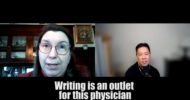
Sandra Miller is a family physician.
She shares her story and discusses her KevinMD article, “How writing fiction can free physicians.”
Did you enjoy today’s episode?
Please click here to leave a review for The Podcast by KevinMD. Subscribe on your favorite podcast app to get notified when a new episode comes out!
Do you know someone who might enjoy this episode? Share this episode to anyone who wants to hear health care stories filled with information, insight, and inspiration.

Hosted by Kevin Pho, MD, The Podcast by KevinMD shares the stories of the many who intersect with our health care system but are rarely heard from.


Transcript
Kevin Pho: Hi, and welcome to the show, where we share the stories of the many who intersect with our health care system but are rarely heard from. My name is Kevin Pho, founder and editor of KevinMD. Today on the show, we have Sandra Miller. She is a family physician, and she wrote the KevinMD article “How writing fiction can free physicians.” Sandra, welcome to the show.
Sandra Miller: Thank you so much. It’s such a thrill to be here.
Kevin Pho: So we’ll get into your article in a little bit, but first off, can you share your story and journey?
Sandra Miller: My story is a little too long, because I’m old. So, to cut to the chase, I really did not follow the normal path to medicine. This was a long time ago, back in the ’70s. I grew up in Illinois, where my college major was actually creative writing, with minors in biology and anthropology, and I came very close, this close, to going into paleontology. But I found that I had some romantic notion of becoming a physician that I kind of needed to get out of my system. So I did apply to medical school. I had all the prerequisites with my biology major, and I figured I would probably end up actually with a master’s degree in biomedical librarianship. I thought that would be just about perfect for me with my background, and I did not expect to get accepted into medical school.
So it surprised me as much as anyone when I found myself going down that path. This was back in the ’70s, a long time ago, when only 10 percent of medical students were women at that time, so that made it doubly surprising that they took a non-science major. Then family medicine was always what I wanted, and after 10 years in private practice, I spent the rest of my career as faculty with the family practice residency at Good Samaritan Hospital in Phoenix. Then I retired. This has been about six years, so you can do the math, and I’m not young. That’s when I started writing novels.
Real physician voices, twice a week
Free, and one click to unsubscribe.
Kevin Pho: Tell me how your background in writing has influenced your career as a physician.
Sandra Miller: Oh, that’s really interesting. I think I’m always aware of people’s stories. There’s quite a trend right now in narrative medicine and writing patient stories. For some reason, fiction has always appealed to me more than the nonfiction part of the story. They serve different purposes completely, but I’m a pretty solitary person, so I enjoy the experience of putting the fiction together. Obviously, a lot of it is based on bits and pieces of people and incidents that I know.
This public health novel that I just published is my fourth novel that’s been published. I have a fifth one coming out next year that’s completely different, and they’re all about women physicians. I just feel like I have a lot to say about that, because there are very few novels, outside of crime scene, that deal with real-life female physicians outside of the hospital. Everything’s based in the ER and in inpatient or surgery.
Kevin Pho: All right, and we’re going to talk more about your writing in the KevinMD article “How writing fiction can free physicians.” Now, for those who didn’t get a chance to read your article, can you just walk my audience through it and share the story of why?
Sandra Miller: Right. I started out, it was kind of ironic that I decided to write this novel about public health. I have some friends in public health here in Phoenix who work for the state health department, and I really admire their work and their work ethic. I decided this would be a great novel to write about such people, and also to set a novel in Phoenix, because surprisingly, very little fiction is set in Phoenix. And so, of course, I set it in the summer, and that explains the title of the book, which is Where No One Should Live. If you’ve ever spent much time in Phoenix in the summer, that makes a lot of sense.
But the article started out just as irony and black humor, that I put together this novel all about public health, really fun, all about the normal public health things that we tackle, and I was finishing the rough draft when the word COVID first started appearing on the scene. So I found this irony of me publishing a novel about public health during a pandemic that’s not about the pandemic. And interestingly, when I tell potential readers that it’s not about COVID, the response is usually, “Oh, well, thank goodness.”
And that got me thinking, you know, when will people want to read fiction about COVID? There was actually a survey done by Penguin Publishing last year, where they surveyed some of their readers: “When do you think you’ll want to read fiction about the COVID pandemic?” And over half of them had no interest. They said, “Don’t do it. Don’t publish that stuff. We don’t want to read it.” A quarter felt like they would never want to read it, and there was a really tiny amount, about 5 percent, who thought that they might have some interest in it.
So my question changed at that point, and my question became, when does society decide it has enough distance between a large-scale tragedy and when they want to actually read fiction about it? Because, I mean, we think of fiction at some level as entertainment, as opposed to nonfiction. So I started looking into this. I started doing the research about it. The most obvious major tragedy of last century would be the Holocaust, and it’s hard to find a list of novels about the Holocaust. I found it on Wikipedia. I don’t know how reliable it is. I found 55 novels, and I looked up each one to see when they were published. In the 1950s, there were three. In the ’60s, there were seven. In the next three to four decades, there were eight to 10 each year. And then, surprisingly, in the decade 2000 to 2010, there were 16. So it seems like the more distance we get from the tragedy, the more that’s written. It’s both the people who experienced it, but they’re aging out, so a lot of it is actually their children, their younger friends, maybe their grandchildren.
So I did the same thing with 9/11, which is much more recent, a much smaller tragedy, but a few books in the first few years. By five years, there were nine, and in the next decade after that, there were 12. So we’ll see if that continues to escalate. And then one more that’s not in the article, because I decided to look up the Vietnam War. There were more novels about the Vietnam War, but they were harder to parse out, because every list I found included fiction and nonfiction. But it looks like the Vietnam War ended in 1975, so in the next decade, there were nine. From ’85 to ’95, there were 23. The next decade, between 2005 and 2015, there were 39. We’re five years past that now, and there have been 19 published so far, so I think by the next decade, it’s still going to be a large number.
So I think what this tells us is it takes us a while to process a tragedy, and if we have the same trend with the pandemic, we’re going to gradually see more and more fiction over the next decades. It’s hard to know, because it hasn’t ended yet. There’s not a finite end, so this may be uncharted territory. But that will probably be written by physicians and health care workers mostly, but everybody’s experienced it, and I think a lot of it will be written by their children and probably their grandchildren, who experienced it at a young age. So we’re kind of in unchartered land as far as my little experiment, and it’ll be interesting to see what develops of that fiction about the pandemic.
Kevin Pho: So it is a challenge. Public health isn’t the most common topic for a novel. Are there any hidden messages about public health that you want your readers to learn about?
Sandra Miller: My main goal was to show the life of a public health physician, because they’re kind of mysterious, and nobody really understands what they do day to day when they go to work. So I shadowed some of these physicians and put together all of the demands that come across their desk day in, day out, and how they get derailed. I wanted to tackle some of the things that are happening in Arizona especially, because that’s what I’ve been exposed to: West Nile virus, mosquito control, parasites in the public swimming pools. There are so many topics, and every other chapter, I try to put in a new topic. I think I write the only novels that have a list of references, scientific references, in fact, so people know that the medicine is accurate and where it comes from.
And so the novels also, you know, they have a story. They have a little bit of a mystery, a little bit of romance, because that’s what keeps the pages turning. Otherwise, you might as well write nonfiction. But I just wanted to show also that physicians are human. They have good days and bad days, and challenges and frustrations, and their triumphs, and that’s what I was trying to put together.
Kevin Pho: So I think that’s really important, showing that physicians are human, and that’s one of the things that I do, certainly on this podcast and on my blog as well. Now, what specific aspects do you include in your novels that show the humanity of physicians?
Sandra Miller: In the Grand Canyon novels, my first three novels were about a young woman physician at the Grand Canyon. She ended up there because she wanted to start over, because she had a fairly crippling anxiety disorder when she was in practice before. She got it treated, she was under control, and she wanted to start over again in a new place. I wanted to show that physicians have the same sorts of problems that everyday people have. We’re not unique in that way.
And I actually got some comments, you know, the reader feedback on Amazon and such, that said, “I’m not sure about this physician. She seems too weak.” And I think that just epitomizes it: People hold physicians on this pedestal where they’re above being human. And so it’s showing how they deal with those kinds of very human situations, and how they move forward, how they still take care of their patients. They don’t compromise their patients. It’s how a physician doesn’t really have excuses. We’re not allowed excuses. We can’t say, “Oh, I missed that. I was tired that day. I had a headache that day,” and how unrealistic that is as well. Those same themes are in the public health book as well. And, you know, people have romance, people meet people, they have feelings and emotions, just like everyone else.
Kevin Pho: We’re talking to Sandra Miller. She’s a family physician, and she wrote the KevinMD article “How writing fiction can free physicians.” Sandra, you mentioned that the protagonists in your books are often female physicians. Why is that important?
Sandra Miller: That’s my experience, so I can write about it most intimately, and also because there is so little of that. Actually, there’s very little fiction being written right now about physicians at all. Abraham Verghese is probably the most prolific writer of physician fiction, and he hasn’t produced a book in a while. I don’t know if he’s working on something other than the crime scene, which is, you know, a completely different genre, and it’s very entertaining, and people enjoy it a lot. But it’s not as realistic, obviously. It’s a pathologist studying blood spatters, and so it’s a completely different kind of entertainment. My novels have a little bit of a mystery, a little bit of a thriller aspect to them, but again, it’s that thing about turning the pages. I just think there’s a place for this, for people to read and to understand what it’s like to be a physician, and what it’s like to be a female physician as well.
Kevin Pho: Now, for those physicians who want to become aspiring novel writers, what kind of advice and tips do you have for them?
Sandra Miller: You just have to sit down and start writing. I have the advantage of having a background in writing, but I certainly didn’t have any background writing a novel. It’s completely different. For most of my life, I wrote poetry, because it’s easier to contain. It’s not easier to write, but it’s easier to contain. And I wrote essays and some medical articles. I would write some with residents that we would try to get published. So I knew little about writing a novel and less about getting one published.
I first had to self-publish, after unsuccessful tries to get an agent, to get a publisher. I got enough good feedback that it kept me going, and I accomplished something that almost no one does, which is I did get a publisher even after I had self-published two of the novels, and they picked them all up. So I’m incredibly indebted to the University of Nevada Press, who was looking for novels about the Southwest, intellectual novels about the Southwest, and all the medicine in mine, I think, is what did it.
Kevin Pho: And my final question, what are some of your take-home messages that you want to leave with the KevinMD audience?
Sandra Miller: I think, for me, the nice thing about writing, and especially writing fiction, is it’s a way to view yourself kind of inside out. It turns things inside out, because there’s a value in seeing yourself in sort of a different way, as a character in a story. And you have to fictionalize it enough that it doesn’t really look like you, because almost everyone writing fiction writes from personal experience, but you cannot assume that what you’re reading is that person, because you fictionalize everything. The way I fictionalize a patient, for example: I usually change their gender. If it happened with a male patient, I turn them into a woman, or vice versa, unless it’s a uniquely male or female issue. I change their age. I change the way they look. I change the disease half the time, so that no one would ever really recognize. And so I do sort of the same thing with the protagonist as well.
But I encourage all physicians to try writing fiction, poetry as well, because it is a way to test your theories of how things work. It’s a great outlet. It’s a good way to vent. To take your favorite patient or your least favorite patient and create a story about them is either uplifting or incredibly releasing. And you don’t necessarily have to show it to anyone, but you might find that you want to. Finding a writer’s group, or a group of people who want to share their writings, I think is really valuable, and you just never know where you’re going to end up with that.
I certainly did not expect, at this point, at my age, to be having a contract on my fifth novel that comes out next year, which, interestingly, is the first one in first person. It is about a middle-aged woman family doctor. Nobody writes novels about middle-aged women much, in first person. She is facing a point in her career where she’s totally burned out and depressed, and she’s giving herself one more year to decide if she’s going to keep it up until retirement or retire early. I had so much fun writing that novel.
Never hesitate to try something that appeals to you. If you’re enjoying it, keep trying it. Figure out what your own measure of success is with something. To be clear, I want people to realize I’m not making any money at this. You have to sell thousands upon thousands of books. Marketing a novel is incredibly difficult. There are millions out there, especially with the Amazon markets and all that. So I do it because I enjoy it. I enjoy it tremendously, and it’s a creative process for me, and I see myself getting better. And so that’s my message: Just find outlets, enjoy them. You just never know what’s going to turn out.
Kevin Pho: And how can people reach you?
Sandra Miller: People can reach me at my website. It’s www.skepticalword.com, all lowercase. That gives you a little bit about my outlook on life, and there’s a link there where you can contact me.
Kevin Pho: Well, thank you so much for sharing your time and insight, and thanks again for being on the show.
Sandra Miller: Thank you so much.
Listen and followApple PodcastsSpotifyYouTubeMore apps · Browse all episodes