Listen and followApple PodcastsSpotifyYouTubeMore apps · Browse all episodes
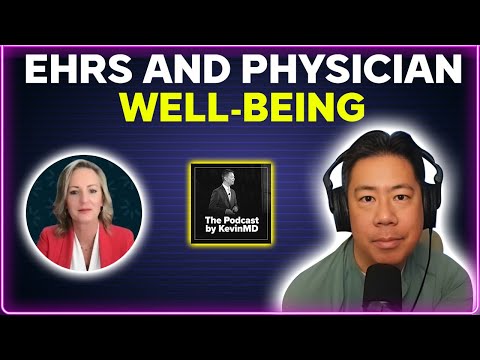
Join Sara Pastoor, a family physician, who brings her expertise to the table as we explore the significant impact of EHRs on physicians’ well-being and the urgent need for change. We’ll discuss recent studies highlighting the burden and burnout caused by traditional EHR systems, the importance of a clinical-first approach to EHR design, and the role of alternative payment models in mitigating physician burnout. Through engaging discussions, we’ll explore innovative ways to measure EHR success, the responsibilities of EHR vendors, and the imperative of supporting health care professionals for a healthier, more efficient health care system.
Sara Pastoor is a family physician.
She discusses the KevinMD article, “It’s time to evolve how we measure the success of EHRs to make us healthier.”

Our presenting sponsor is Nuance, a Microsoft company.
Together, Microsoft and Nuance are leveraging their rich digital technology and advanced AI capabilities to tackle some of health care’s biggest challenges. AI-driven technology promises to revolutionize patient and provider experiences with clinical documentation that writes itself.
The Nuance Dragon Ambient eXperience, or DAX for short, is a voice-enabled solution that automatically captures patient encounters securely and accurately at the point of care. DAX Copilot combines proven conversational and ambient AI with the most advanced generative AI in a mobile application that integrates directly with your existing workflows.
Physicians who use DAX have reported a 50 percent decrease in documentation time and a 70 percent reduction in feelings of burnout, and 85 percent of patients say their physician is more personable and conversational.
Discover AI-powered clinical documentation that writes itself. Visit https://nuance.com/daxinaction to see a 12-minute DAX Copilot demo.
VISIT SPONSOR → https://nuance.com/daxinaction
SUBSCRIBE TO THE PODCAST → https://kevinmd.com/podcast
RECOMMENDED BY KEVINMD → https://kevinmd.com/recommended
GET CME FOR THIS EPISODE → https://earnc.me/ZOwc8F
Powered by CMEfy.
Transcript
Kevin Pho: Hi, and welcome to the show. Subscribe at KevinMD.com/podcast, and get CME for this episode by clicking on the CME link in the show notes. Today we welcome back Sara Pastoor. She is a family physician and physician executive. Today’s KevinMD article is “It’s time to evolve how we measure the success of EHRs to make us healthier.” Sara, welcome back to the show.
Sara Pastoor: Hi, it’s so good to be here. Thanks for having me back.
Kevin Pho: So Sara’s been on multiple times. Go to KevinMD.com/podcast to hear her story and prior episodes, you can search her name. But today let’s jump right into this KevinMD article. What’s it about, for those of you who didn’t get a chance to read it?
Sara Pastoor: Well, so I work for an EHR company, and that is called Elation Health. And physicians have very little influence over the technology that they use, and it really has a huge impact on their experience of delivering care.
And historically EHRs, I think, have not done a very good job of being built around the clinical experience and what it takes to drive better health outcomes, and also just to support the physician and the clinical team in delivering better care. And we know that EHRs are driving a lot of stress and burnout, extra administrative burden, with repetitive tasks, unnecessary clicks, things like that.
And so we really are trying to take a good hard look at ourselves as an EHR company, and also issue a call to action for the EHR industry and other health technology platforms, to take a look at how we are impacting clinicians’ ability to deliver better care and to do that efficiently, effectively. What is their experience of stress and burnout, how is the EHR impacting that, how much admin burden are they experiencing, and is their EHR doing enough to help drive that down?
Kevin Pho: So you obviously, as you said, work for an EHR company. Take us behind the scenes, and it doesn’t have to be your company of course, but in general, how are these EHRs constructed, who does the programming, and the people doing the programming, how much interaction do they have with practicing clinicians so they know how their product is being used on the front lines?
Sara Pastoor: Yeah, that’s a fantastic question, and this is something that I love to talk about. Of course I have an experience of an n of one, I’ve never worked at another EHR company, so I don’t really know how they do business. But I have the perception or the belief that the way we do things at Elation is probably different than the status quo.
And that is because of the birth story of Elation, where Elation was literally built inside a family medicine practice. And so that sort of is where we developed this product development approach of being tightly knitted with our front-end user, to really iterate on the product by getting feedback directly from the user and trying to make sure that this feeds into a better clinical experience.
So 14 years later, after the product was first developed, we’ve still worked really hard, even as we’ve grown and scaled, to maintain that development philosophy of doing discovery with front-end users, really understanding what their needs are, delivering an alpha version of the product, getting them to bang on it and tell us what’s broken or what doesn’t work, and then iterating on it some more, so that we can really get to that best, right solution.
Kevin Pho: So tell us a little bit about that loop specifically at your company. So if there was a product and a group of physicians, I assume through some type of work group, say that this isn’t working or this needs to be fixed, how long does it normally take for that feedback to be incorporated into the next version?
Sara Pastoor: So this is interesting, because there is a method, and I presume this is true for all EHR companies, for customers to submit feature or enhancement requests. And your audience might be surprised to learn that EHR companies get thousands of those a day. And there’s certainly overlap, but it becomes a challenge to prioritize those and really figure out what you’re going to work on, because you don’t have infinite resources to apply to that development work.
And how long that takes, and the iterative process, varies depending on the amount of investment that’s required from a human labor standpoint, et cetera, in bringing that to market.
And so what we do at Elation is, we identify customers that are really trying to exhibit the highest version of what we’re looking for in clinical practice, and understand what their workflow needs are, and then build to those requirements. And we just open the door to feedback and tell us everything that’s broken, let us work on that with you, help us understand exactly what that looks like. So we have designers and we have product developers and we have clinicians like me who really try to help translate that back to the software engineers to build the thingamabob that then those front-end users will use.
Kevin Pho: Why is it that a lot, and you could certainly speculate on this because I know you only work at Elation, but why is it that so many other EHR companies don’t have that strong connection between what’s going on on the clinical end versus what’s going on in the developmental end? Talk about some of the barriers that really separate those two worlds, from your experience in the EHR world.
Sara Pastoor: Of course I can only speculate, and this could be completely wrong. I think that one of the main barriers is that it takes a lot more resources to do development in this way. It takes more time, it takes more people, it’s much more of a methodical, plodding process, versus having an idea of how to improve the product internally, creating the thing and tossing it over the fence and assuming that everything is fine.
And so really trying to invest in getting it right the first time, and working with users, visiting them on site, watching them do the thing, or understanding what they need in order to be clinically and financially successful, and building that into the product, takes a lot more investment and a lot more time. And I think if you want to build a business that is going to sell fast, maybe you don’t want to take the time and investment to do that.
Kevin Pho: I was reading the latest survey on physician burnout, and I think one of the top reasons leading to burnout is of course administrative tasks and EHRs. So I think that EHRs in general are contributing to a significant amount of clinician burnout. Tell me, from the standpoint of an EHR company, what are the benchmarks of success? What makes a successful EHR? Is this simply revenue? Is clinician satisfaction even a factor in that? What contributes to an EHR company’s success?
Sara Pastoor: I think it started out being about revenue, productivity, the billing cycle. That’s how legacy EHRs were really, that’s where they were really focused in terms of what made them successful.
And I think that that has expanded over the past decade to be a little bit more focused on what the front-end user needs. And so we do see moving in that direction. And we also see companies like KLAS and Gartner, Black Book, surveying, as third-party surveyors of technology users, asking them about their sentiment about various platforms and then publicly reporting that.
And they are asking things like, is this bringing value, is it worth the money, is this company delivering on new technology enough, are they supporting your integration needs, is their customer support good, things like that.
But what they’re not asking, and what I think is this new frontier that we need to dig into, and I’m not even sure other EHR companies are even asking this of their customers, we do, is, how is this impacting your experience of administrative burden? How is this impacting your daily experience of stress and burnout? How is this impacting your documentation burden, which is the number one driver of both stress and burnout and administrative burden? And then looking for, where are clinicians spending most of their time, and how can the EHR impact that?
So what makes a good EHR sell more? Certainly there’s user experience there. It depends though a lot on who the EHR decision maker is. So if you’re working in a big health system, the EHR decision maker is not going to be the front-end user, most likely. If you’re in an independent practice, then it’s more likely to be the person who actually is also going to be using the product.
Kevin Pho: One of the things that you said earlier is that some EHR companies, it’s easier to have an internal idea, implement it and see what the response is. At Elation specifically, those internal ideas, how much knowledge do they have in terms of what the front-end user is experiencing? Do those internal ideas have a basis in clinical medicine, or someone who has an expertise in clinical medicine?
Sara Pastoor: Honestly, I have been so incredibly impressed with the amount of clinical expertise and insight that I’ve seen in non-clinical people who are on the design team or in other areas of product development. And I think that comes from years of working in this space side by side with our front-end users to really understand their needs. And so this insight and expertise that they have in how clinical workflow happens has really impressed me.
But one of the reasons that they hired a physician, me, is to really help deepen that and bring my clinical expertise to the product development. And so it’s a regular thing that they’re working on some new enhancement and they get me involved to say, does this look right, does this feel right, do you prefer A or B, that type of thing. And then we take it back to customers and say, what do you think? And then we iterate from there.
Kevin Pho: Now, whenever you mention EHRs in general to a group of clinical physicians, the response is almost universally negative, right? They’re always going to complain about something. Do you think that’s unfair, speaking on behalf of an EHR company?
Sara Pastoor: No, I don’t think that’s unfair. I mean, they’re the front-end users, we have to get this right for them.
Certainly what we saw as the whole industry moved from paper records over to electronic health records, in theory we understood what the benefits would be, but in practice we saw that we were spending a tremendous amount of time sitting at a computer typing. Not that I didn’t used to take patient charts home after work and handwrite those notes, I absolutely did that after the kids went to bed.
But still, we’re spending a lot of time feeling like a secretary sitting at the computer typing. And patient information would get lost, or we would not know where to find what we’re looking for in the chart, and you’re rooting around looking for the thing that you want, and there’s no way for you to manage how the chart is designed.
And so we’ve had a lot of aggravation and grief come from this transition, and it’s valid. And they’re the front-end users, the ones on the front lines trying to take care of patients, and so we’re just the helpers in the background trying to make their job easier.
Kevin Pho: What do you see as some of the current and future trends that we can expect in EHR systems? Of course everyone talks about AI. Is that something that you’re seeing on the front end in terms of what we have to expect next? And if not AI, what are some other ideas that we have to look forward to?
Sara Pastoor: Again, I can’t speak on behalf of other EHR vendors, but yes, AI is taking off. And I think that there are many ways that AI can help us in terms of not just documentation burden. We’re seeing AI used as an ambient scribe, and that is really changing the game. But also AI to help draft letters to specialists, or convert an encounter note into a patient facing care plan that’s in lay terms, to do a first draft of response to messages, to triage things. I mean, there’s all kinds of ways, to do a chart review and find important information that is relative to X question in this moment. So there’s many, many things that we can do with AI to really help elevate that charting experience.
But I think the next frontier, for me at least, my vision, and we’re working on this at Elation, is, historically, because of the fee for service payment model and how EHRs were developed out of that, we’ve been very focused on the transaction of the encounter and how we document the encounter note. And I think that the future of EHRs is, instead of being centered around encounter notes, it will be centered around a concept of comprehensive longitudinal care planning.
So we want to know a comprehensive view, especially in primary care, of what are all the problems that my patient has, what are their goals of therapy, what are their health goals in general, what are the steps that we’re going to take to achieve those goals, what are the barriers to achieving those goals, who’s responsible for which piece, which task, and making sure that we are all aligned around the same plan, so that it integrates all the different players that are involved in a patient’s health, and also gives the patient visibility into what it is we’re doing and what their responsibility is. Because health doesn’t happen inside that 20 minute encounter, it happens when the patient goes out and knows what to do.
So I would love to see EHRs centered around care plans, and the encounter notes just feed into that.
Kevin Pho: Is that going to require a fundamental change in terms of how we reimburse health care clinicians? Because as you know, it’s very episodic, we’re only paid on that fee for service 15 to 20 minute visit that has to be documented. So to bring your idea or your ideal to light, is that going to require a fundamental change in terms of how physicians are paid?
Sara Pastoor: I mean, I think we need a change in how physicians are paid anyway, whether we do that or not. But I think it would be symbiotic, because if you’re going to be successful in what we’re calling value based payment models, you’re going to have to drive clinical improvement in your patient, and I don’t think there’s a better way to do that than by having a shared care plan.
And so inasmuch as we are trying to drive better outcomes at a lower cost of care, the care plan will help with that, and we’re going to need those care plans if we want to get there. So I think that that is a good feedback loop there.
Kevin Pho: We’re talking to Sara Pastoor. She’s a family physician and physician executive. Today’s KevinMD article is “It’s time to evolve how we measure the success of EHRs to make us healthier.” Sara, as always, we’ll end with some of your take-home messages to the KevinMD audience.
Sara Pastoor: OK, well, I guess take-home message number one would be, expect more from your EHR. Are we evaluating whether or not our EHR is helping us get through our day and take better care of patients?
And I think physicians, if we organize, have the ability to demand better for ourselves. We’ve sort of gotten into this learned helplessness, and we’re just putting up with whatever. And you don’t have to settle for an EHR that is chosen by an institution, that is made to maximize fee for service revenue. You can go into independent practice and you can choose an EHR that actually is built for the work that you do, especially in primary care.
And I think that we all together need to unify voices to tell EHR companies that we expect you to drive down our administrative burden, we expect you to provide us some relief here. And I’m hopeful that we’re going to get there if we continue to send that message.
Kevin Pho: Sara, as always, thank you so much for sharing your perspective and insight, and thanks for coming back on the show.
Sara Pastoor: Thank you for having me.
Listen and followApple PodcastsSpotifyYouTubeMore apps · Browse all episodes