Listen and followApple PodcastsSpotifyYouTubeMore apps · Browse all episodes
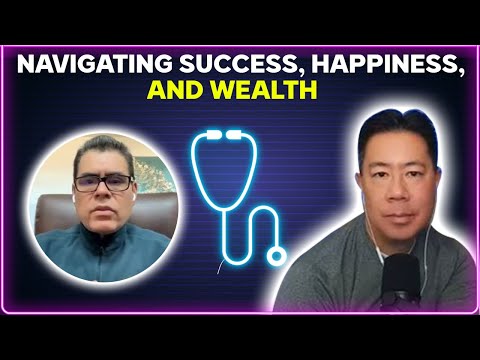
In this episode, hospitalist Miguel Villagra explores the key components of success, happiness, and wealth and how they are interconnected. He sheds light on the art of reacting to life’s offerings, the relationship between happiness and money, and the conversion of effort and enterprise into currency and equity. Join us as we delve into the good life and the importance of a fully developed lifestyle that provides a constant sense of joy, deep value, and achievement.
Miguel Villagra is a hospitalist.
He shares his story and discusses his KevinMD article, “Character, not cash: the ingredients of a happy and meaningful life.”

The Podcast by KevinMD is brought to you by the Nuance Dragon Ambient eXperience.
With a growing physician shortage, increasing burnout, and declining patient satisfaction, a dramatic change is needed to make health care more efficient and effective and bring back the joy of practicing medicine. AI-driven ambient clinical intelligence promises to help by revolutionizing patient and provider experiences with clinical documentation that writes itself.
The Nuance Dragon Ambient eXperience, or DAX for short, is a voice-enabled, ambient clinical intelligence solution that automatically captures patient encounters securely and accurately at the point of care. Physicians who use DAX have reported a 50 percent decrease in documentation time and a 70 percent reduction in feelings of burnout, and 83 percent of patients say their physician is more personable and conversational.
Rediscover the joy of medicine with clinical documentation that writes itself, all within the EHR.
VISIT SPONSOR → https://nuance.com/daxinaction
SUBSCRIBE TO THE PODCAST → https://kevinmd.com/podcast
RATE AND REVIEW → https://kevinmd.com/rate
FOLLOW ON INSTAGRAM → https://www.instagram.com/kevinphomd
FOLLOW ON TIKTOK → https://www.tiktok.com/@kevinphomd
GET CME FOR THIS EPISODE → https://earnc.me/6kg59I
Powered by CMEfy.
Transcript
Kevin Pho: Hi, and welcome to the show. Rate and review at KevinMD.com/rate. Subscribe at KevinMD.com/podcast. Today on the show, we have Miguel Villagra. He is a hospitalist. His KevinMD article is titled “Character, not cash: the ingredients of a happy and meaningful life.” Miguel, welcome to the show.
Miguel Villagra: Thank you, Kevin. Thank you for having me.
Kevin Pho: So we’ll get into your article in a little bit, but first off, briefly share your story and journey to where you are today.
Miguel Villagra: Sure. I’m an internal medicine physician who was born and raised in Nicaragua. I went to medical school there and practiced internal medicine there for some time. I did academic and hospital medicine, and then I moved to the United States to restart my life over again. Here, I have dedicated my life to hospital medicine, which I still enjoy a lot.
A little bit before, but also during COVID, I started to do some telemedicine work, so I also work as a tele-hospitalist in some rural areas of Texas, which I enjoy a lot because there’s a large Hispanic community that I’m now serving. And last but not least, lately I have also dedicated myself to doing a little bit of coaching. I’m also coaching other physicians who struggle with burnout, and I’m very excited and passionate about that as well.
Real physician voices, twice a week
Free, and one click to unsubscribe.
Kevin Pho: So tell me about tele-hospitalist work. What’s that like?
Miguel Villagra: You know, it’s a very interesting experience. At first, I was kind of dreading it, but I guess the push of COVID, how it changed the way we practice medicine, and the fear of having another pandemic in the future prompted me to kind of pull the trigger and do it. It’s interesting how the technology has improved to the extent that you can actually offer really good care in a virtual visit from home, including how you can even hear heart sounds and lung sounds remotely. I think the technology has become so good that all you need now is a strong Wi-Fi signal and good headphones to listen with.
Kevin Pho: So how do you round? Like teleradiology, do you have some type of robot or surrogate who can do heart sounds and physical exams? I’m curious about that process.
Miguel Villagra: Absolutely. The way it works, the way I do it, I have two screens. On one, I have the EMR open, so I can see the labs on the patients and things like that. On the other, I have the camera connected to a portal, where there is a nurse on the other end who guides a little device that they carry, and you interact with the patient. Interestingly, I haven’t had any issues, even with patients with hearing loss, which was one of my fears. They can definitely listen, or you have the same challenge that you would have in a regular physical visit anyway.
When the time comes for you to do a physical exam, they will help you and guide you. They have this machine, they put the stethoscope on, and you are basically listening in real time through your headphones to the lung sounds and heart sounds. The only thing is the abdominal physical exam; that’s the part that’s a little bit more tricky. You get the nurse to kind of help you with that, but that would be kind of the main challenge, I would say, in my personal experience doing it so far.
Kevin Pho: All right, we’ll have to do another episode talking about that. I find that fascinating. But let’s talk about your KevinMD article that you wrote earlier. It’s titled “Character, not cash: the ingredients of a happy and meaningful life.” Now, how did this article come together?
Miguel Villagra: You know, it came from my own personal experience. I have seen this recurring theme in physicians, but also in my own personal life, which I’ll describe as the arrival fallacy. It’s the idea that when you get to this point, or when you have something, you’re going to be happy. In my personal life, I did it while I was holding a leadership position as a medical director. I was in that position of “If I get to this point, I’m going to be happy,” and so on and so forth, or “If I have a certain income, a certain amount of money, I’m going to be happy.” Usually, we’re talking about material things.
But to be honest with you, even though I’m all for goal setting, which is quite important, and I definitely advise any physician to set their goals, financial, professional, and so on, we also cannot ignore that we should focus on enjoying the journey in the present moment. That’s where the article is coming from: that idea that you need to try to find happiness in the now, and not only that, but enjoy the process of getting to the goals that you are setting.
Kevin Pho: So how does this relate to physicians specifically? Give us an example or story, be it from your own life or from your coaching.
Miguel Villagra: Yeah, I can give you two, actually. The first one would be, once again, from my personal life. I’m coming from a very poor country, right? So we moved to the United States to have a better life. So there is that idea of getting more, and when we get more, we’re going to be happier. As a matter of fact, I’m going to tell you, Kevin, when I was doing this whole journey as a medical director and things like that, each time I was holding a higher position with a higher income, you would say I was closer to the definition of success I had at the time, but my quality of life was just going down. It was the complete opposite of the direction my career was going.
And I recently had a client who was in a similar situation, where we’re talking about money. He was OCD about getting to a million dollars of wealth. He was all for it, and it was very specific: “That’s my goal. That’s my financial target.” He was working, I would say, out of 30 days, at least 28 days of the month. He was definitely ignoring his family. He ended up having a lot of personal issues with his family and things like that, which I’m not going to get into in detail out of privacy. But the point is that he was not enjoying his life, even though he was getting to his goal.
And that’s what the article is about: How can you find that meaning in life in the present moment? You cannot ignore the process at any step of your life. To me, it’s like chapters. Your life is in different chapters, and you need to enjoy each of them. That’s what the article refers to.
Kevin Pho: So what kind of questions can physicians ask themselves to describe that relationship between money and happiness? Because that’s going to be a different answer for every physician, right? Every physician is going to have different values. So what kind of questions can they ask themselves to better define where they are on that money-happiness spectrum?
Miguel Villagra: Yeah, there is a simple, powerful question: the why. Why are you doing it? And what are your priorities in life? What is important for you? You need to see if why you’re doing it matches your priorities, what is important for you. You will be surprised how many times there is a complete mismatch between what your priorities are and why you’re doing all this.
Kevin Pho: So what’s an example of that?
Miguel Villagra: I mean, a simple example would be, going back to the money part, if your goal is to have X amount of money, but your priorities are to be with your kids and your wife, and then you need to work 28 shifts a month in order to get to that point, there is clearly a mismatch between what you want and what you are going to get, or what you need to do to accomplish that goal.
And that has been part of the change for me. Again, going back to my own personal example, I was so busy at the time. I was chewed up, swallowed, and spit out by corporate. That’s the best way to describe how I was at the time in those positions. I was just unhappy. I was ignoring my life, and I had to put on the brakes, Kevin, and say, “OK, what are my priorities?” If I want to be with my family, sometimes you need to sit down and make decisions that are tough.
And I’m going to give you a tough decision I made myself: I gave up that job. I quit that job without even having another job at the time. I’m so grateful that I was able to get the job I was seeking in a short period of time. But I reached that breaking point where I was like, “I have to do something about it. I’m just not finding enjoyment and fulfillment in my life anymore.”
Kevin Pho: Now, what was it like during that breaking point? Because a lot of physicians may not know what that point is, where they have to make those difficult decisions. For you, you said that you quit the job without having another job in hand. What was that breaking point for you? Just describe what that moment, or those days, were like for you.
Miguel Villagra: Yeah, so they were busy, with extended hours. But it was also that, with physicians, you know the value you have, all the training and everything, and it’s easier for physicians to ignore all the signs, the red flags, that this is happening. For me, I was getting to a breaking point where I was already checking the DSM manual to see what psychiatric disorder I might have, because I was so unhappy. And I didn’t fulfill any of those criteria. I said, “I do need help. I don’t feel well, but I definitely don’t have any psychiatric disorder.” So when I started looking and digging into it, I said, “This is definitely not good for me, because I don’t know what will come next.” That was kind of the eye-opener. It was very difficult for me.
Kevin Pho: Now, what’s the relationship between that arrival fallacy and physician burnout? Do you find that a lot of physicians strive for, say, a certain dollar amount? Do you think that’s perhaps a contributor to the increasing frequency of clinician burnout?
Miguel Villagra: You know, burnout is definitely a phenomenon that is work-related, right? And our health care system is so chaotic, disorganized, and disconnected, and definitely we cannot ignore that. However, I think part of the problem, too, is that idea of how you react to your external environment. That’s the part we need to work on a lot: our mind and our thoughts. I think a lot of physicians have this struggle with how they react to their working environment.
I can tell you, our health care system needs to change; there’s no doubt about it. But physicians who are coming from a place of enjoyment and fulfillment are definitely the ones who will change it, because if you’re coming from resentment, frustration, and victimhood, you’re definitely not going to be in a position to change much.
Kevin Pho: So for those physicians who are listening to you right now, what’s the immediate next step that they should take?
Miguel Villagra: Well, I would say, first, it’s OK to be vulnerable, because a lot of the pushback I’ve heard from physicians is that vulnerability becomes a sign of weakness. I ignored that myself. I had those signs that I was not doing well, that I was not happy. And sometimes you also need to make a change like I did, but I’m not saying that works all the time. Maybe what you need is just to work a little bit on your mind, on your mindset, instead of necessarily changing your job or position. But definitely, being vulnerable is OK, and if you feel that you need help, seeking that help is definitely advisable.
And once again, there’s always this paradigm of who comes first, the patient or the doctor. I always make the analogy of the flight. They always tell you to put your oxygen mask on first before you can help somebody else, and we ignore that simple fact all the time.
Kevin Pho: And my final question: Tell us some take-home messages that you want to leave with the KevinMD audience.
Miguel Villagra: Yeah, so I’ll piggyback on the fact that if you feel you need help, there are great resources out there for physicians, and there are a lot of organizations that help physicians who are struggling with their wellness. I would say take care of your mind, of your thoughts, of your body: exercise, diet, etc. So don’t ignore those simple things, even your sleep. A lot of physicians don’t even have the time to sleep enough or well. So don’t ignore those simple things for your wellness; that would be my advice and my take-home. They are things that sometimes we take for granted, because we’re in these lives where everything goes on automatic, with a lot of distractions.
Kevin Pho: Miguel, thank you so much for sharing your time and insight, and thanks again for being on the show.
Miguel Villagra: Thank you for having me, Kevin.
Listen and followApple PodcastsSpotifyYouTubeMore apps · Browse all episodes