Listen and followApple PodcastsSpotifyYouTubeMore apps · Browse all episodes
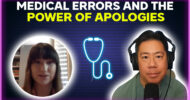
In this episode, Alisa Sano, a public health research assistant, shares her personal story of loss and the impact of medical errors on families.
We will explore the complexities of the health care system, including the “swiss cheese model” and authority gradient, and the importance of open communication between health care providers and patients.
Alisa emphasizes the importance of health care providers taking responsibility for their mistakes and the impact of simple apologies on families. She also encourages patients and their loved ones to be proactive in advocating for their own health and safety.
This is a must-listen episode for health care professionals and those who have experienced the devastating effects of medical errors.
Alisa Sano is a public health research assistant.
She shares her story and discusses her KevinMD article, “Don’t lie about medical errors. Apologize.”

The Podcast by KevinMD is brought to you by the Nuance Dragon Ambient eXperience.
With a growing physician shortage, increasing burnout, and declining patient satisfaction, a dramatic change is needed to make health care more efficient and effective and bring back the joy of practicing medicine. AI-driven ambient clinical intelligence promises to help by revolutionizing patient and provider experiences with clinical documentation that writes itself.
The Nuance Dragon Ambient eXperience, or DAX for short, is a voice-enabled, ambient clinical intelligence solution that automatically captures patient encounters securely and accurately at the point of care. Physicians who use DAX have reported a 50 percent decrease in documentation time and a 70 percent reduction in feelings of burnout, and 83 percent of patients say their physician is more personable and conversational.
Rediscover the joy of medicine with clinical documentation that writes itself, all within the EHR.
VISIT SPONSOR → https://nuance.com/daxinaction
SUBSCRIBE TO THE PODCAST → https://kevinmd.com/podcast
RATE AND REVIEW → https://kevinmd.com/rate
FOLLOW ON INSTAGRAM → https://www.instagram.com/kevinphomd
FOLLOW ON TIKTOK → https://www.tiktok.com/@kevinphomd
GET CME FOR THIS EPISODE → https://earnc.me/VntRHz
Powered by CMEfy.
Transcript
Kevin Pho: Hi, and welcome to the show. Rate and review at KevinMD.com/rate. Subscribe at KevinMD.com/podcast. Today on the show we have Alisa Sano. She is a public health research assistant. Her KevinMD article is titled “Don’t lie about medical errors. Apologize.” Alisa, welcome to the show.
Alisa Sano: Thanks so much for having me. I’ve been following your platform since 2011, so I’m so excited to be here.
Kevin Pho: Well, thank you so much for joining me. Alisa is joining us from Tokyo, Japan. I understand it’s three in the morning over there.
Alisa Sano: Yes, yes.
Kevin Pho: Great. Well, thank you so much for getting up. We’ll talk about your article in a little bit, but first off, just briefly share your story and journey to where you are today.
Real physician voices, twice a week
Free, and one click to unsubscribe.
Alisa Sano: Sure. I grew up in rural Japan with my grandparents and my single mom, who is a pianist. Playing the piano was a big part of my youth, and so were the English language and American culture, which I naturally gravitated to. I taught myself English until I went to an international school for high school, and then I went to the University of Michigan, where I studied pre-med and medical anthropology. Clinical experiences there as a medical scribe and interpreter led to my interest in med school.
The problem with that was that as an international student, a non-green card holder, I had a very limited choice of U.S. med schools to apply to. I ended up quitting the med school I went to after realizing that their unique curriculum would not help me secure my work visa during residency, nor would it help me become the type of clinician I wanted to become. I did not want to do a disservice to my future patient populations, because I lost my grandfather to medical mistakes, and that was really important to me. So it was one of the toughest decisions I had to make.
After withdrawing from med school, I shifted towards population health and studied public health at Johns Hopkins, with a focus on HIV epidemiology and clinical informatics. Currently, I’m working as a public health auditor and doing research on the association between heart failure and HIV status by studying inflammatory biomarkers.
Kevin Pho: So let’s talk about your KevinMD article. It’s titled “Don’t lie about medical errors. Apologize.” So how did this article come together?
Alisa Sano: Growing up as the daughter of a single mom, I was really close to my grandfather, so losing him to medical errors hit me really hard. To this day, I still have this unresolved feeling after almost 10 years. It wasn’t so much that medical errors happened that bothers me, but the way in which they were handled.
My grandfather was recovering from pneumonia at the hospital in Japan and was supposed to come home the following week. My mom happened to be with him on that day, and the nurse mentioned in the morning that she was a bit concerned about his fluctuating blood pressure. When my mom came back around 6 p.m., she noticed that his heart rate was getting lower and lower. She frantically kept pressing the nurse call button, but no one came, so she rushed to the nurse station to find out that no one was there and the heart monitor at the station was turned off. So she went back to my grandfather and spent the last three minutes with him, watching his heart rate drop to zero.
It turned out that the resident who was taking care of my grandfather was not sure how to handle my grandfather’s condition, but did not notify his attending. After my grandfather’s death, my mom wanted to know what exactly happened, so she asked the attending to let her talk to the resident. But the attending told her that he was worried about the resident losing his confidence and damaging his career, so he did not let my mom speak to him.
As I started writing this piece, I realized that I had a strong message that I wanted to convey to health care providers and patients’ families, and I wanted to do so by telling my story, capturing what happened on that day scene by scene. Writing this, I felt close and distant to my story. I’m distant because a part of me was doing the postmortem as a public health professional, reflecting on medical errors and systems thinking.
Kevin Pho: What was the conversation like between your mother and the attending? How did the attending explain the situation?
Alisa Sano: My mom really wanted to know the truth, from the beginning to the end, from the morning to the moment that my grandfather passed away. And the attending was not apologetic; that is what shocked us. We were not able to get the whole medical record either. So to be honest, everything is still unknown in a way. We do know that there was no physician there when that was happening, but we didn’t know what exactly happened, and that’s what we wanted to know: the facts, the story. Since the attending and the resident never disclosed that, we were always in the dark. Because we didn’t know, we didn’t know how to resolve it, and that’s why we still have this unresolved feeling.
Kevin Pho: Did you or your family talk to anyone else at the hospital, an administrator or anyone else outside of the resident or the attending?
Alisa Sano: Yes, we did. We tried to talk to the administration and the nurses who were taking care of my grandfather. But I think in Japan, the authority gradient between nurses and health care clinicians, there’s a strict hierarchy. I know that in the States there is some of that too, of course, to some extent, but in Japan it’s much steeper. So I think when it comes to medical errors, it’s very hard to really pinpoint the specific people or health care providers and ask them what happened.
Kevin Pho: And then what was the response that you received from the administration of the hospital?
Alisa Sano: It’s up to us to bring up the conversation.
Kevin Pho: You mentioned that this happened years ago, and there’s still a feeling that everything is unresolved. Talk more about that. Talk more about the impact that this event, and the subsequent response, has had on your mother, you, and your family.
Alisa Sano: Sure. So to be honest, it is still an ongoing battle among us, because my mom really cannot trust health care providers now, and that’s totally understandable. But at the same time, I come from this public health background, and I told you I was feeling distant in a way, because I was analyzing medical errors and systems thinking. When I look at the series of events that led to my grandfather’s death, several key themes jump out, like authority gradient, situational awareness, and alarm fatigue.
At Hopkins, I took this course on patient safety and medical errors by Drs. Albert Wu and Peter Pronovost, which has had a tremendous impact on me. I learned that the root cause of medical errors, or any kind of incident, is not the individual who made the error, but the systemic or organizational factors that allowed it to happen. We often use the Swiss cheese model, which is a mental model for system safety. Each cheese layer represents a protective action or protocol, so it could be a read-back or a checklist. Each hole, or latent error, represents multiple weaknesses, such as human error, communication lapses, and caregiver fatigue. When these holes align, patient harm happens. So to strengthen these layers of protection, we need to focus on what happens between each incident or lapse, and on how workflow strengthens and weakens these protective layers.
Donald Norman, who advocates for user-centered design, said that each instrument may be designed quite well and work perfectly, but when you put it together as a system, it’s a disaster. When I look at what happened to my grandfather, I think the same thing can be said about hospital staffing, too. Everyone wants to do the right thing; everyone wants to save a patient. But different key players or stakeholders, like doctors, nurses, social workers, pharmacists, and hospital administration, have different priorities, and when they work together without much coordination, everything falls apart. So we have to view these medical errors within the context of the hospital ecosystem, because human factors are all interrelated. But it took me about 10 years to come to this point, where I can calm down and really be able to analyze it.
Kevin Pho: Stepping back and being able to analyze it now, speaking again through that public health lens, what kind of changes would you have recommended this hospital in Japan undertake so that something like this would never happen again?
Alisa Sano: I believe in minimizing the authority gradient. I mean, of course, there’s always a cultural component, so it is a little tricky to actually implement it, but I think maybe.
Kevin Pho: In your ideal world.
Alisa Sano: My ideal world?
Kevin Pho: The ideal world. What changes would you make to prevent something like this from happening again?
Alisa Sano: More honest communication among health care providers, and also with the patient. Right now there’s a strict hierarchy that prevents us from communicating to clinicians what we fear and what we are worried about. So I think if we can break down those barriers, if the patients’ families can more proactively ask questions, and if we have a welcoming environment where people can honestly share what they’re worried about, what they fear, and what they want to know, I think that will make a huge change.
Kevin Pho: If you were able to talk to that resident, what questions would you have asked?
Alisa Sano: I would want to ask how differently he would want to act the next time he is in this kind of situation. Since I have never talked with that resident, I don’t know where he was coming from, or what his mindset was when that was happening. Maybe he felt this authority gradient towards his boss, the attending physician, and maybe that’s why he did not bring it up. So I really want to know how exactly he is going to use this lesson for his future patients, because I know that no one is perfect and there’s always a learning opportunity. I know that all health care providers want to do the right thing, and I really want to know how he can use this lesson to save future patients.
Kevin Pho: If you were to talk to the attending again, and the attending offered an apology, would that have made a difference to your mother and your family?
Alisa Sano: I do believe so. I do believe the simple words “I’m sorry” and “thank you” would have made a huge difference. I know there are so many liability issues, like medical malpractice litigation, and physicians might be reluctant to disclose everything. But I believe that when patients and family members want to sue you, it’s not just because there are some errors. It’s when you do not openly discuss what happened; that’s when you feel betrayed, disappointed, angry, and hurt. All we want is the true story and a simple “I’m sorry.” At the end of the day, family members and health care providers want the same thing, which is to save human lives one at a time. So a simple apology and disclosing all the facts would have made a huge difference.
Kevin Pho: We’re talking to Alisa Sano. She’s a public health research assistant. Her KevinMD article is titled “Don’t lie about medical errors. Apologize.” Alisa, for those health care professionals, physicians, residents, and medical students who may be listening to you and your story now, what lessons can they learn from hearing all about this?
Alisa Sano: I would say that patients and their family members know that you, as health care providers, are heroes, but also human. So talk to us as you would talk to your parents and your friends, including what you are unsure about and what you fear. And to anyone whose loved ones are in the hospital: You can fight for your loved ones. Go fight for yourself, and share what you fear. Ask questions, ask your health care providers to share what they’re unsure about, and ask them what they fear.
Kevin Pho: And my final question: Tell us some of the take-home messages that you want listeners to come away with.
Alisa Sano: Have conversations with health care providers. Ask them what’s on their mind, ask them to share what they fear, and also share what you fear.
Kevin Pho: Alisa, thank you so much for sharing your story, time, and insight, and thanks again for coming on the show.
Alisa Sano: Thank you so much.
Listen and followApple PodcastsSpotifyYouTubeMore apps · Browse all episodes