Subscribe to The Podcast by KevinMD. Catch up on old episodes!
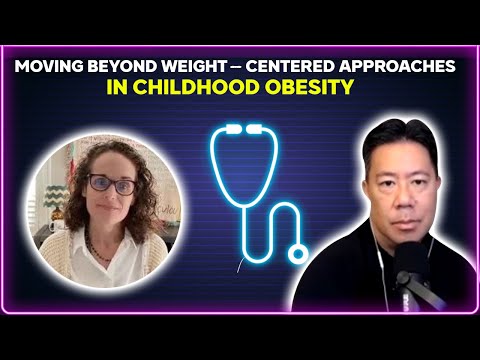
In this episode, we sit down with guest Wendy Schofer, a pediatrician, to discuss the current state of childhood obesity and the need for a change in approach. Over the past two decades, the prevalence of children being diagnosed as overweight and obese has increased. However, the reasons behind this are still unknown. The conventional approach to childhood weight focuses on controlling it, but labeling it creates shame and fear, which can negatively impact mental health. Wendy advocates for shifting the focus from weight to improving the relationship with food, bodies, and our kids. Join the conversation and learn how to promote healthy lifestyles for children.
Wendy Schofer is a pediatrician.
She shares her story and discusses her KevinMD article, “It’s time to stop focusing on family weight.”

The Podcast by KevinMD is brought to you by the Nuance Dragon Ambient eXperience.
With so many demands on their time, physicians today report record levels of burnout. Burnout is caused by many factors, one of which is clinical documentation. Studies indicate physicians spend two hours documenting care for every hour spent with patients.
At Nuance, we are committed to helping physicians do what you love – care for patients – and spend less time on clinical documentation. The Nuance Dragon Ambient eXperience, or DAX for short, is an AI-powered, ambient clinical intelligence solution that automatically captures patient encounters securely and accurately at the point of care. Physicians who use DAX have reported a 50 percent decrease in documentation time and a 70 percent reduction in feelings of burnout, and 83 percent of patients say their physician is more personable and conversational.
Rediscover the joy of medicine with clinical documentation that writes itself, all within the EHR.
VISIT SPONSOR → https://nuance.com/daxinaction
SUBSCRIBE TO THE PODCAST → https://kevinmd.com/podcast
RATE AND REVIEW → https://kevinmd.com/rate
FOLLOW ON INSTAGRAM → https://www.instagram.com/kevinphomd

ADVERTISEMENT
FOLLOW ON TIKTOK → https://www.tiktok.com/@kevinphomd
GET CME FOR THIS EPISODE → https://earnc.me/igJ2uF
Powered by CMEfy.
Transcript
Kevin Pho: Hi, and welcome to the show. Rate and review at KevinMD.com/rate. Subscribe at KevinMD.com/podcast. Today we welcome back to the show Wendy Schofer. She’s a pediatrician, and her KevinMD article is titled “It’s time to stop focusing on family weight.” Wendy, welcome back to the show.
Wendy Schofer: It’s such a pleasure to be back here with you again, Kevin.
Kevin Pho: So Wendy’s a regular guest, so if you want, go to KevinMD.com/podcast, search for Wendy Schofer’s prior shows, and you’ll hear all about her story. But today I want to jump right into your KevinMD article, titled “It’s time to stop focusing on family weight.” It’s certainly relevant, because the recent AAP, American Academy of Pediatrics, guidelines on obesity have been in the news recently. But tell us, how did your article come together?
Wendy Schofer: It’s been quite a bit of time. It’s funny how my article actually starts off with the story of a headline that I clipped back in 2008, which was “Fat kids die earlier,” and it stood out to me so much back then. It was a very dramatic headline, but the thing is that it was actually reinforcing so much of what I was believing in my own practice: how we need to shine a light upon the concerns about increasing weight, that we really need to have a call to action and to focus on it, kind of like “name it to tame it.” That really stuck with me over time, because this is the first headline that I ever remember seeing about overweight. I mean, they definitely existed beforehand, but it really stood out.
And as I took it with me over time, I just felt like it wasn’t the approach that was actually helping in my own clinic, with my patients, and with my families. So it was kind of like this double-edged sword of catching attention, but is it the right attention?
Kevin Pho: Now, you obviously articulate the tension between that old headline and how you approach obesity in your own clinic. So tell us, how do you approach obesity in your clinic with your patients and your families?
Wendy Schofer: So it’s about the impact of all the messages that we’re receiving about weight in our homes, weight and health, because they are really tied together at this point. It’s really hard to separate out the two. But it’s really helping parents understand how much their concerns about their child’s weight fit into a bigger picture: about their health, about their family, and also about the job that we’re doing as parents. And so when we’re talking about that focus and that attention, what I’ve found is that the more that we focus upon the weight on the scale, on the food, on how much our kids are moving, the more friction we’re bringing up and the more problems we’re creating. It’s actually kind of backfiring: We’re placing that focus and that attention in what we think is the right place, but it’s ultimately not helping us.
Kevin Pho: So what should we focus on instead?
Wendy Schofer: OK, so do you remember when you were learning how to drive? Maybe it’s because I grew up in Pennsylvania, where we had icy, slippery roads, but I learned all about it. They said that if you are losing control, you’re slipping on the road, and you’re like, “Oh my gosh, I’m going towards the fire hydrant,” what do you do? You don’t focus on the fire hydrant. You don’t focus on the telephone pole, or whatever it is that you’re going towards that you don’t want to go to. You have to focus on where you want to go.
That sticks with me because I did take out a fire hydrant at work. That’s why the fire hydrant comes up as my example. I totally just zoned in on the fire hydrant, “Don’t go there, don’t go there,” and I took it out, and my grandmother will never let me live it down. But it’s the same thing: The more that we focus on what it is that we’re trying to avoid, the more that we focus on it, the more it’s like trying to outrun it or escape from it, but we keep on looking back at what’s still chasing us and what the risks are here, and it’s not actually helping us get to where we want to go.
So I remember that driving analogy all the time: Focus on what I want, where I want to go. And psychologically, it definitely is helping. It’s not just for our cars and avoiding hazards, but really asking, what is it that we want to create? Where is it that we want to go, as opposed to what is it that we’re trying to avoid or escape?
Kevin Pho: So can you take us into your exam room and maybe tell us a story or a case study where you could apply those principles in action?
Wendy Schofer: I love this story with Emily and her mom. Emily was six years old, coming in for her well visit, and I was just meeting her for the first time. I did all of the initial review. I always would go over the vitals and the growth charts right as the child was checked in, and I noticed that she was growing consistently over the 85th percentile for her weight, so that would qualify as a diagnosis of overweight. I made a mental note of that and then just dove into the rest of the visit. I asked about her eating habits, about her movement, about her academics, socially, everything, how things were going at home, and there were absolutely zero red flags.
And Mom was kind of looking at me weird, and I was like, “What’s going on here?” So I asked, “What other questions or concerns do you have?” And she said, “What about her BMI? Like, what about it?” She said, “I have always heard from all the doctors about how she’s greater than the 85th percentile for her weight, for her BMI, that she’s overweight, and that I’m doing it wrong.”
So it was really sad, because everything that this mom had ever taken away was that she was doing it wrong, that she was failing at raising her child to be healthy, or whatever that bigger picture was for her, that she wasn’t succeeding, even though we had just gone over all the things that they were doing just spot-on. That took me some time to really learn the language of, but it was something that I noticed she kept on coming back to: Everybody was focusing on the weight to define how she was doing at raising her child and how her child was doing at being healthy.
And so we flipped the conversation: What else can we use here to be able to evaluate how you’re doing? Look at all these things that you are doing well. Look at all the things that are supporting how healthy she is. I didn’t have the words for it at that time, OK, but the things that I would look at now would be: What is it that you want to create? What is it that you want for your family? What is it that you want for your child? It’s switching from focusing on the weight telling us how we’re succeeding or we’re failing here to what is the bigger picture of what it is that we really want to create for our families.
Kevin Pho: And when you flipped that conversation, as you said, what was the reaction of Emily and her mother?
Wendy Schofer: I can’t speak to Emily at that point in time. I’ve got to tell you, it was much more of a conversation with Mom. Emily was in her own world, having fun at the doctor’s office. Mom breathed a sigh of relief, and that’s where it starts. It’s just that so often the parents are telling me about feeling like they don’t need to carry this burden anymore, just the relief of letting it down. And it takes time, because it’s not like this instantaneous thing where you’re thinking, “Oh, OK, I won’t do that anymore.” We’ve gotten this messaging for so many years about defining health as a certain weight or weight percentage, and there are so many different messages about that. It’s really something that’s going to take time, I think, and just the repetition to be able to unlearn that.
And that’s why, honestly, that’s why I share these stories. That’s why I do this, because I see what is possible with the families that I work with, and that possibility is so much stronger than what we’re getting from all these headlines, which is basically how everything is impossible: “Look at these numbers and data,” all of this evidence of what I think of as the doom-and-gloom headlines. Well, that’s where we are right now. Where do we want to go? Where do we want to go? Focus on what it is that we want to create.
Kevin Pho: Now, speaking of headlines, we are speaking towards the end of January, and by the time this podcast publishes, it’s going to be sometime in February. And coincidentally, the American Academy of Pediatrics released, according to its headlines here, the first comprehensive guideline on evaluating and treating children and adolescents with obesity. That was released earlier in January. It wasn’t without controversy, but what were your impressions of the AAP’s guidelines?
Wendy Schofer: I think that it’s something where we really have an opportunity as a medical community to really look at how we can be on the same page right now as far as helping patients and helping families. I still think that there’s more that we can do that’s beyond the medical evaluation, looking at how we can connect as humans, understanding what all of this means for us around weight. There’s still, with the guidelines, just even the concept of the guidelines, like, “This is what you need to do.” I have my own challenges with that, because I really look at the personalized approach, that it’s the art in working with humans around weight and around health.
It’s definitely a starting place, and there’s so much more that we can grow and work with the individual and see where it is that they want to go and what it is that they want to focus on. So I work a lot more on, oh gosh, yes, definitely motivational interviewing, but more so from the perspective of helping the families, helping the parents take back some of that control and the autonomy in their house about what it is that they want to create, and not just, “This is the stepwise approach that you need to take.”
Kevin Pho: So you told the story earlier about Emily and her mom, and how Emily’s mom breathed this sigh of relief after talking to you. Can you share another success story where your approach has moved the needle when it comes to addressing obesity?
Wendy Schofer: A more recent example is with a client that I have in my program who approached me from the perspective of, “I need help with my child. I have concerns about his weight, and I want to know what I can do to help him.” It’s something where, as we work together in the program, I don’t ask anything about a child’s weight. I don’t actually ask how much they weigh, and that’s the difference with a coaching program versus a medical program. It was really understanding what the concerns were that the mom was bringing into the program, how that was impacting her family, what it was that she was afraid of for her son, as well as what her concerns about his weight meant for her.
As we worked together over time, it’s not like this set path of, “OK, well, first you need to talk about the weight, and talk about the food, and talk about the exercise and the sleep.” They’re all interrelated, absolutely. But what we did is we started unraveling those concerns that she had, and she realized over time that her son’s weight wasn’t actually something that was concerning to him. It was actually something that was concerning to her. Her son’s weight was all impacting her: her concerns for the future, her concerns for body image, for how he was doing, how he would do socially. But the thing is that it was never impacting him or bothering him at all. It was actually just impacting her experience.
So as we were working together, she learned that the focus on his weight was actually creating more struggles for herself. Thinking about all the things that she thought she was doing wrong was also creating resistance at home around the food fights and making him go out and move and exercise in ways that he wasn’t looking to do. And as we worked over time, what she realized is that it was something that she didn’t have to be concerned about. They were sorting it out together, and they were creating relationships that were much longer-lasting than just focusing on the here and now of the weight.
Kevin Pho: We’re talking to Wendy Schofer. She’s a pediatrician. Her KevinMD article is titled “It’s time to stop focusing on family weight.” Wendy, what kind of tips can you share with other pediatricians or family physicians? Because they receive a lot of conflicting guidelines. Obviously there’s that new one that just came out. So what kind of advice can you share with them?
Wendy Schofer: I’d say taking everything with a grain of salt, seeing what works for you, for your family, for your patients. We have a lot of information, a lot of tips and tricks. I mean, even going back to when I was dispensing these in the office, I was like, “Why isn’t this working? I’m giving them all of the information about how to eat, how to move, all these things,” and then it just wasn’t connecting with my patients. Understand that there are going to be parts that work and parts that don’t. Just look for the pieces that you want to take and build upon, and just keep on experimenting to see what works, what fits, what you want to keep on doing, what you need to do a little bit more of just to see if it really works, and what you just want to discard.
Kevin Pho: And my final question: What are your take-home messages that you want to leave with the KevinMD audience?
Wendy Schofer: Oh my goodness. Focus on what it is that you want. Focus on what you want to create, what you want to go towards. The focus that we have on trying to run away, or to be afraid of something, focusing on what we fear, isn’t helpful, and we’re exhausted from trying to run away from things and battle and fight all of them. Let’s look at where we want to actually go.
Kevin Pho: Wendy, thank you so much for sharing your time and insight, and thanks again for being on the show.
Wendy Schofer: Thank you so much. It’s such a pleasure.