Subscribe to The Podcast by KevinMD. Catch up on old episodes!
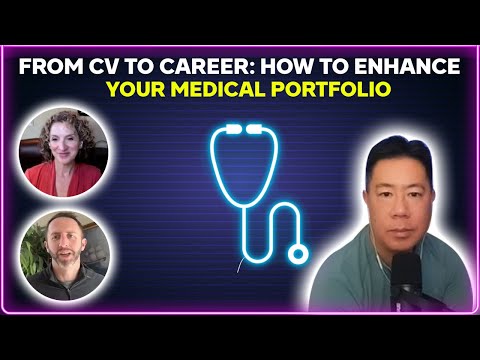
In this episode, we’re talking about how to stand out from the crowd in a competitive job market for physicians. Our guests, Aaron Morgenstein, a board-certified orthopedic surgeon, and Claire Unis, a pediatrician, will discuss how to enhance your portfolio with individual content to supplement your CV.
In a post-pandemic world, more and more physicians are looking to leave their current positions and explore new opportunities in telemedicine, utilization management, med-legal review, and industry consulting. But with a growing pool of applicants, it’s becoming increasingly challenging to stand out from the crowd with just a great CV and cover letter.
That’s why we’re proposing that you take your job search to the next level by building an impressive portfolio of your work. Whether it’s through creating online articles, designing a website, publishing in peer-reviewed journals, participating in a podcast, or going back to school, there are many ways to enhance your portfolio and set yourself apart from other applicants.
So tune in to hear insights and tips on how you can build a strong portfolio and become a sought-after physician in the job market.
Aaron Morgenstein is a board-certified orthopedic surgeon and founder, FlexMedStaff.com, a fully transparent and free marketplace for physicians to find new clinical and non-clinical opportunities to improve work-life balance. He can be reached on Twitter @flexmedstaff.
Claire Unis is a pediatrician and author of Balance, Pedal, Breathe: A Journey Through Medical School.
They share their stories and discuss the KevinMD article, “Having a great CV is not enough: Start building your portfolio.”

The Podcast by KevinMD is brought to you by the Nuance Dragon Ambient eXperience.
With so many demands on their time, physicians today report record levels of burnout. Burnout is caused by many factors, one of which is clinical documentation. Studies indicate physicians spend two hours documenting care for every hour spent with patients.
At Nuance, we are committed to helping physicians do what you love – care for patients – and spend less time on clinical documentation. The Nuance Dragon Ambient eXperience, or DAX for short, is an AI-powered, ambient clinical intelligence solution that automatically captures patient encounters securely and accurately at the point of care. Physicians who use DAX have reported a 50 percent decrease in documentation time and a 70 percent reduction in feelings of burnout, and 83 percent of patients say their physician is more personable and conversational.
Rediscover the joy of medicine with clinical documentation that writes itself, all within the EHR.

ADVERTISEMENT
VISIT SPONSOR → https://nuance.com/daxinaction
SUBSCRIBE TO THE PODCAST → https://kevinmd.com/podcast
RATE AND REVIEW → https://kevinmd.com/rate
FOLLOW ON INSTAGRAM → https://www.instagram.com/kevinphomd
FOLLOW ON TIKTOK → https://www.tiktok.com/@kevinphomd
GET CME FOR THIS EPISODE → https://earnc.me/czArZE
Powered by CMEfy.
Transcript
Kevin Pho: Hi, and welcome to the show. Rate and review at KevinMD.com/rate. Subscribe at KevinMD.com/podcast. Today on the show, we have Aaron Morgenstein and Claire Unis. Aaron is an orthopedic surgeon; Claire is a pediatrician. I’ve had each of them on the show individually, and now they’re here together. We’re going to talk about their KevinMD article, “Having a great CV is not enough: Start building your portfolio.” Aaron and Claire, welcome to the show.
Aaron Morgenstein: Thanks for having us.
Claire Unis: Thank you, Kevin.
Kevin Pho: All right, so we’ll get into your article in a little bit, but for those who didn’t listen to your individual episodes in the past, just briefly introduce yourself and share your story to where you are today. So Aaron, why don’t you go first?
Aaron Morgenstein: Yeah, so I’m an orthopedic surgeon. I discussed this on your podcast recently, but I do about 16 days or so a month, and that gives me the opportunity to pursue other passions. I was in private practice for two years, loved those people, and then I moved on. When I moved on, I was able to seek out other opportunities, things within my clinical practice but outside my clinical practice, which is what kind of got this article started with Claire.
Kevin Pho: And Aaron, why is it important for physicians to pursue other passions, sometimes outside of clinical medicine?
Aaron Morgenstein: I think that clinical medicine is stressful. It can be overwhelming. I think that there are a lot of variables that go into treating patients, and I think when I was a resident, I didn’t understand or recognize all those variables. Those variables begin to wear on you, and when they wear on you, you get burned out or suffer from moral injury, whatever you want to call it these days.
I think that physicians must start to recognize other passions. Now, it could be ballroom dancing, or it could be becoming a real estate guru, or it could be working with insurance companies. But I think that we should all find ways to stay in clinical practice but also have other passions that we can pursue, either for fun or for financial gain, and it’s the reason why we kind of came up with this article.
Kevin Pho: All right, Claire, so again, for those who didn’t listen to our individual episode together, just share your story to where you are today.
Claire Unis: Sure, thanks. So I am a pediatrician. My path deviated from typical in that when I was in medical school, I decided I really wanted to write about the experience of becoming a doctor. So I took a step to the side and got my master of fine arts in writing, actually six months after I graduated from medical school, and then I went on to residency and got busy. But I always wanted to write, and so I came back to it a couple of years ago and started to figure out: How do we incorporate writing into our lives? How can we not only use it as a tool to combat burnout, but as a way to express what we experience as clinicians, as physicians specifically, and to contribute to sort of the national discourse about what is going on in medicine right now?
Since then, I’ve been trying to find other ways to use writing and medicine, not only to help other clinicians, but to broaden our experiences. So for example, that could be in the form of narrative medicine; I lead some book clubs, things like that. So I really found that for me, the literary arts have been my side interest when it comes to medicine.
Kevin Pho: So Claire, I’m going to ask you a similar question. On this podcast, I’ve talked to a lot of doctors who are more than their degrees. They do so much more than clinical medicine, like each one of you does. But we’re a relative minority, because there are a lot of doctors who say all you have to do is see patients, all you have to do is go to the hospital, and if you pursue interests outside of clinical medicine, maybe you’re less of a doctor. Now, to those physicians who have that mindset, what do you say to them?
Claire Unis: Well, again, I’m talking more specifically about writing, but there’s a degree of self-reflection that happens in writing, and a degree of self-knowledge, that only contributes to your humanity and your ability to continue to find purpose in your work as a doctor. I think also patients really want to connect with us as people, not just as technicians of their body’s physiology. The more well-rounded we are as humans, the more experiences we have as humans, the better we can relate to the people that we take care of. So that well-roundedness is extremely important for our own well-being and also for our ability to perform our medical jobs well.
Kevin Pho: All right, so let’s talk about the KevinMD article that both of you wrote. It’s titled “Having a great CV is not enough: Start building your portfolio.” So Aaron, how did this article come together?
Aaron Morgenstein: Well, I think I was on social media, and I put it out there that I was interested in working with someone to write some articles about writing for blogs or writing articles, and what we could do as physicians that goes outside of our traditional work. Someone connected me with Claire, and it’s been a great relationship. I think we’re two articles in now, and we have a third one in the works, but working with Claire has been great. Now, my push, or what I see, I should say, is that I see a lot of physicians who are unhappy out there, and I think in life as a physician, a lot of things.
Kevin Pho: What do you mean by that? When you see a lot of physicians who are unhappy, what exactly are you seeing that makes you think that?
Aaron Morgenstein: I think it’s everything I see on social media. So maybe I have blinders on, because I don’t see all 900,000 physicians who are out there, but the ones that I see are complaining about their current situations or looking for something else. I think this article was meant for those people. As we all on this podcast understand, we need to have something that we can pursue outside of medicine to keep us sane, and we wanted to reach out to those people to kind of say, or have them think about, or think outside the box about, how they could do things a little differently to become an expert.
We wanted people to realize that not everything’s handed to you. We went to med school, we went to residency, and then someone handed us a six-figure salary, and we were happy. Well, if you want to start a side passion or a side hustle, it’s not that easy. No one just hands you something. If you want to become a coach, or you want to become a specialist in some kind of manner, finding other ways to become that specialist, or be known as a specialist, takes time and effort, and it just doesn’t happen overnight. That was the purpose of the article: to highlight all the ways that physicians can get their voice out there, or get their voice heard, so that people start coming to them, and they start building volume and credibility and become that expert they’re hoping to become.
Kevin Pho: All right, and Claire, tell us a first step. So let’s say I’m a physician listening to this podcast for the first time, and really, you guys are opening up that world, that there is more to my professional life than clinical medicine, and I want to take my CV in different directions. Tell us some of the first steps.
Claire Unis: I think the first step is self-knowledge, right? You have to decide where you want to go with that, and that can be very difficult. Most of us are complex people with multiple interests, and figuring out which of those interests you want to develop next is not necessarily straightforward.
I’m a big fan of journaling. In a lot of the classes that I teach, we may read something or look at a piece of art and then do just a very short reflective write: Set a timer for three minutes and just let yourself write. Don’t edit. See what comes out of it. You’ll probably end up writing for longer than three minutes. But I think that’s a really important first step: Just check in with yourself. What is it that you want to do? And then from there, there are different steps that you can take, depending on how you want to develop the skills that you are really interested in pursuing and/or have been wanting to pursue for years, and you’ve deferred it because of the medical journey and the medical training journey.
Kevin Pho: And Aaron, let’s say you take Claire’s advice and you have a portfolio of articles. In your article here, you have some tips in terms of how you can have more publicity and how you can create more of a platform so those articles could be read. Tell us about some of those ideas.
Aaron Morgenstein: Yeah, so I think the easy ones that we can talk about are just sit down and start writing, and if you need any help, I’m happy to work with anyone. Working with Claire has made me a better writer, so it’s been fantastic. So one way of doing this is to write something up and submit it to platforms like KevinMD and see if you can get it published. Then you get that endorphin release, and you get excited, and you want to do others, and you want to share your voice with others. So there are several of those platforms, like yours, where you really can get your voice out there pretty quickly.
I think we talked in the article about peer review. Certainly you could publish articles in the journals, or the academic journals. You don’t always have to do research; you could do an op-ed as well. And I know that Claire has many other ways that we do it. I think one of the things both of us have done is we’ve both created websites, and we’ve allowed those websites to be our platform for people to hear our voice. I think it’s very easy these days, a few bucks or several hundred bucks, however much you want to spend, to build a website and start telling the world what you believe. You can also just go on social networks like LinkedIn, Twitter, all those, and start networking with people and adding a significant amount to the conversation.
Kevin Pho: Why is it important to have your own website? Now, for those doctors who may not have the resources or time, or think creating a website is too big a hill to climb, and perhaps just want to live on social media, why is it important for you to have your own website?
Claire Unis: I think it just provides you, what’s the word, a place to put your writings, to link to everything that you’ve written. It’s a way of having, if you will, a multimedia CV, right? You can list what you’ve done, you can link to articles, you can show artwork if you’re into art, you can link to websites that matter to you. So it allows you to kind of create an expression page for yourself, and it also allows people to learn more about you. So as you engage in these conversations on social media, if someone says, “Gosh, I really wonder what that person’s about,” they’re able to find out information the way that you want them to, not by Googling and reading whatever patient reviews are out there. But who are you, really? This is your opportunity to express yourself.
Kevin Pho: And Claire, what do you say to those physicians who may think that they have nothing to say? Sometimes if you ask physicians to write or share stories, they may not think that their lives are interesting enough, or they may not think that what they have to say is interesting enough, and that’s come across a lot from my experience. So what do you tell those physicians who aren’t sure what to write about or think they may not have anything interesting to say?
Claire Unis: Gosh, I think even with my love of writing, there are times that I feel like I have nothing to say, and that’s generally where free writing can be helpful. Just make yourself write for three to five minutes and see what comes out. I think that’s very helpful. I think reading is really helpful. The more that you read, and read other people’s opinions, the more you’re going to be able to land on whether you agree or disagree with what you’re reading. So be engaged not just in written media, but also on social media. What are other people saying? Do you agree with what’s being said?
Sometimes those conversations really help you hone your opinion, and often you’ll find you can’t really express yourself fully in that kind of an environment. That’s an opportunity to sit down and write about it a little bit more and see what you really may have lurking in there, because most of us have more to say than we realize at first blush. When we’re in the throes of taking care of patients and practicing clinical medicine, or maybe doing research, and taking care of children, and all of the other things that are part of just being humans in this world that keep us busy, we need a little bit of time and space, and maybe a little provocation, to figure it out.
Kevin Pho: Now, one of the things I said earlier, and I really want to reinforce this theme, is that physicians are more than our degrees. So I want to ask each of you about your activities outside of clinical medicine. Tell me what kind of doors they’ve opened, what kind of opportunities you’ve come across that you wouldn’t have otherwise. So Aaron, why don’t you go first?
Aaron Morgenstein: Yeah, so for orthopedics, it takes about two years to get board-certified, and once you get board-certified, which is two years after residency, doors really start to open up. Once you get that board certification, you can act as an industry consultant, you can do med-legal work, you can do insurance work, you can do nonclinical work. It opened up doors for me once I started board certification.
But I think what a lot of people have to realize is that I had to kind of open up these doors myself. I had to go out there and talk to other folks, like Claire, and I had to network, and I had to take very low-paying jobs to learn different languages. And I’m not talking about actual languages; I’m talking about different languages related to different industries. Once I was able to do that, I’ve become somewhat successful in my nonclinical career, which complements my clinical practice.
Kevin Pho: And Claire, you’re a writer. Tell me some of the doors that have opened for you from your nonclinical passions.
Claire Unis: So the first one that comes to mind is going to sound rather random, but there is a group of physician women equestrians. It’s actually a Facebook group, and through that group, it’s amazing the networking that has been able to happen, the amount of information that has been shared. So figuring out other people who share some of your interests and passions can really open networking opportunities. I have found out about writing opportunities through this group. I have seen many people network, find jobs, find new places to live, find horses also. But this has been kind of an eye-opening experience, especially in the era we live in, where networking has become so easy with social media, where these other interests can link you to people unexpectedly, and you find that you have support in places you didn’t even know existed.
The other way, I would say: I was writing while I was in medical school, and I did finally finish that book. What I wrote about was all of my outdoor interests, for the most part, so each chapter is linked to one of the other things I enjoy doing. There’s one that’s about rock climbing, for example, and that’s linked to uncertainty in medicine. Having those links has allowed me to connect with people who have read the book or want to know more about various aspects of it. So again, it’s amazing how much people want to connect over these seemingly random interests and passions that we have.
Kevin Pho: And what kind of tips do you have for physicians to go on and search for other physicians, or clinicians, or people who may have similar interests?
Claire Unis: That’s a great question. I feel like it’s so serendipitous and random sometimes. I think it’s just the act of engaging in what other people are mentioning. I think a lot of the people who have joined this group have casually mentioned in some other forum riding horses, and then they get invited to join, or we find out that there are these common interests. Having your eyes open when you’re on these groups, and hearing what people are writing about or talking about, can allow you to make those connections. And don’t be afraid to reach out. Don’t be afraid to send a message and say, “Hey, I didn’t know that you were a rock climber too, and it seems like you live close to me,” or whatever it might be.
Kevin Pho: We’re talking to Aaron Morgenstein and Claire Unis. Aaron’s an orthopedic surgeon; Claire’s a pediatrician. Together they co-wrote the KevinMD article “Having a great CV is not enough: Start building your portfolio.” So Aaron and Claire, I’m going to ask each of you for your take-home messages to the KevinMD audience. Aaron, why don’t we start with you?
Aaron Morgenstein: I think my take-home message, and hopefully it really says it clearly in the article, is that you have to think outside the box. If you want to pursue other passions, get started now. Start building something small and build it up into something bigger. And it’s not easy, but med school wasn’t easy, OK? Residency wasn’t easy. And you can really get started today in building that passion you have on the side. It may be something that’s financially driven, or maybe something that’s not, like riding horses or whatnot, but there are many things out there you can do as physicians.
The other thing that Claire and I always speak about is that to pursue these things, you have to work outside your normal hours. So you have to get up two hours before your kids wake up in the morning, or stay up two hours beyond the time when your kids go to bed. This is what I recall, or I’ve read, is the new five-to-seven and the new nine-to-eleven. But you have to work harder than you’re currently working if you want to pursue these other passions.
Kevin Pho: And Claire, what are some of your take-home messages?
Claire Unis: I have really enjoyed working with Aaron on this article, and I hope that you guys will take a look at it, because there are many different ways to establish yourself in various fields, various interests, and new careers. I think that’s really where this article came from: the idea that many people, many physicians out there, are burned out on clinical medicine. They’re looking to re-establish themselves in a different career path, and there are several ways to leverage what we know and what we have experienced as MDs in order to develop ourselves in a new direction. We have so much to offer the world. It does not have to be honed into a tiny little box working for corporate medicine.
So I hope you guys will check it out. I think we put a lot of thought into this article, and one of the beautiful things about working together on it is we were able to really edit it down to something that I think can be useful. Thank you so much for your time.
Kevin Pho: Aaron and Claire, thank you so much for sharing your time, insight, and stories, and thanks again for being on the show.
Aaron Morgenstein: Thanks, Kevin.
Claire Unis: Thank you.