Subscribe to The Podcast by KevinMD. Catch up on old episodes!
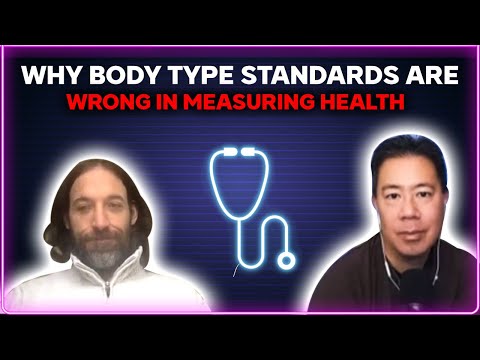
In this episode, we explore the concept of normal weight obesity and skinny fat with scientific researcher Marc Nelson. Marc discusses how genetics, diet, exercise, and lifestyle all play a role in determining our body type, and how new research is helping us better understand the complex relationship between body shape and health. Tune in to learn more about this important topic and how it can help us address the obesity epidemic and improve overall human health.
Marc Nelson is a scientific researcher.
He shares his story and discusses his KevinMD article, “Why body type standards are wrong in measuring health.”

The Podcast by KevinMD is brought to you by the Nuance Dragon Ambient eXperience.
With so many demands on their time, physicians today report record levels of burnout. Burnout is caused by many factors, one of which is clinical documentation. Studies indicate physicians spend two hours documenting care for every hour spent with patients.
At Nuance, we are committed to helping physicians do what you love – care for patients – and spend less time on clinical documentation. The Nuance Dragon Ambient eXperience, or DAX for short, is an AI-powered, ambient clinical intelligence solution that automatically captures patient encounters securely and accurately at the point of care. Physicians who use DAX have reported a 50 percent decrease in documentation time and a 70 percent reduction in feelings of burnout, and 83 percent of patients say their physician is more personable and conversational.
Rediscover the joy of medicine with clinical documentation that writes itself, all within the EHR.
VISIT SPONSOR → https://nuance.com/daxinaction
SUBSCRIBE TO THE PODCAST → https://kevinmd.com/podcast
RATE AND REVIEW → https://kevinmd.com/rate
FOLLOW ON INSTAGRAM → https://www.instagram.com/kevinphomd

ADVERTISEMENT
FOLLOW ON TIKTOK → https://www.tiktok.com/@kevinphomd
GET CME FOR THIS EPISODE → https://earnc.me/7ARvEA
Powered by CMEfy.
Transcript
Kevin Pho: Hi, and welcome to the show. Rate and review at kevinmd.com/rate. Subscribe at kevinmd.com/podcast. Today, we welcome back to the show Marc Nelson. He’s a scientific researcher. His KevinMD article is titled “Why body type standards are wrong in measuring health.” Marc, welcome back to the show.
Marc Nelson: Thank you for having me on, doctor.
Kevin Pho: For those who didn’t get a chance to listen to our first episode together, just briefly share your story and journey to where you are today.
Marc Nelson: Yeah, so when I was young, I noticed that my body was different than many of my peers. I had skinny fat all over. At the time, there wasn’t a term “skinny fat,” and because the BMI is the current standard, I was always well within my safe BMI, but I was lacking muscle and muscle mass all over my body. I have dealt with that my entire life.
So I started the scientific research so that I could start to bring forward the data to show that not everyone is born in body type one, the standard body type one, which you find in any scientifically approved human body anatomy book. I have been held to that standard my entire life, even though I have had skinny fat all over my body. That’s how I started with the scientific research.
Kevin Pho: Since our first episode, it certainly enlightened me when it comes to skinny fat, or normal-weight obesity. So, in general, when you talk to other health care professionals, how prevalent is the acceptance of the concept of skinny fat or normal-weight obesity?
Marc Nelson: Not very. It’s definitely an up-and-coming term. It’s become more accepted in the last decade or so. But again, because the BMI is the scientific standard, and the BMI fails to calculate any form of skinny fat, just as body type one and the BMR fail to incorporate any form of skinny fat, it’s simply not accepted right now. That is what our scientific research is looking to do: improve the scientific body type standards so that they are more accurate.
Kevin Pho: All right. So let’s talk about your KevinMD article and some of those traditional measures of health, “Why body type standards are wrong in measuring health.” How did this article come together?
Marc Nelson: Well, our goal here at Fellow One Research is to strengthen the current standards. We are scientists, we believe in science, and we believe in having standards. That’s how medicine and science work: We have data, we have definitions, and we have standards that we can hold patients to. You as a doctor would know this, but we also know that with our standards, we have to start somewhere.
So we’re not necessarily knocking the three body type standards, which again are body type one, the BMI, and the BMR. We’re simply saying that the research data is very clear now that those standards are not accurate, and they need to be strengthened. The only way that we can do that is to bring forward the scientific data to show, one, that they are not accurate, and then two, how do we actually strengthen those three body type standards?
We do that by understanding the variables that are currently not being calculated, and that is skinny fat in all of its forms: cellulite, thin fat, loose skin, saggy skin, crepey skin, and normal-weight obesity. If we can better understand what skinny fat is and begin to incorporate it into the three currently accepted body type standards, we can make them more accurate, which benefits everyone from doctors to patients to the health care system in general.
Kevin Pho: So let’s talk about those three traditional body type standards. The first one is the standard scientific human anatomy book body type, BT1. Talk about that one.
Marc Nelson: Yeah, so you as a doctor know that if you have a patient who comes in to your office, you have that standard image that you find in any scientifically approved human body anatomy book, which shows the human body with all the muscle and muscle mass fully developed. If you’re an adult human being, that’s technically what your body looks like, because that’s the current standard.
So again, we’re not going against that standard. We are simply saying that not every human is born in body type one. I most certainly was not. We need to better understand what happens genetically if you’re someone like me, in whose family obesity is common. I did not have all that fully developed muscle and muscle mass on my body from day one. I was always lacking it, and in place of that muscle and muscle mass was skinny fat.
I pointed it out very early on. When I was around 8 years old, I pointed it out to my parents and the doctors. Again, because I was well within my safe BMI weight range, nothing else really mattered, because that was the standard. If you’re within your safe BMI, you’re automatically body type one, and that’s just how it is. That’s one of the reasons why our scientific data is looking to incorporate skinny fat into both body type one and the BMI calculation, so that we better understand it and can better diagnose it and deal with diet, exercise, and lifestyle as such.
Kevin Pho: The second standard you mentioned earlier is body mass index. Tell us what is wrong with that, and how would you improve it?
Marc Nelson: It came about in the 1800s, and it became the official standard in the mid-1980s. Again, we believe in having standards, so we’re not necessarily saying that we should get rid of the BMI, but it fails to calculate any form of skinny fat. And if you think of somebody like Dwayne Johnson, The Rock, or Brock Lesnar of the WWE, anyone like that who has excess muscle and muscle mass on their body, it also fails to calculate excess muscle and muscle mass.
So the BMI right now fails to calculate any form of skinny fat, and it fails to calculate excess muscle and muscle mass. It’s not necessarily a difficult fix. It’s just understanding that skinny fat is a real thing. How do we define skinny fat so that we can add it into the BMI calculation? How do we define excess muscle and muscle mass so we can add it into the BMI calculation? That’s what we are working on in terms of our science: bringing forward that data so that we can further strengthen the BMI calculation and make it more accurate.
Kevin Pho: So would it be a modifier to the formula if we were living in your ideal world? How would you modify the BMI to account for skinny fat?
Marc Nelson: Well, that’s a tough one right now, because to really bring forward the scientific data to understand the skinny fat variables, because there are multiple forms of skinny fat, we would need to move our research into the next stage, which is what we are working on. We would need an MRI machine or machines, and to bring patients in so that we could run them through the MRI and get a sense of what their default muscle mass is versus their default skinny fat, so that we could begin to calculate what the actual averages are. Once we have those standard averages, we could then begin to add them to the BMI calculation.
Again, we are working on that, but it takes time to build to that. Right now, we have our online scientific body type quiz, with which we can identify skinny fat, but it’s not as accurate as we would like it to be for us to truly bring forward the skinny fat variable and add it to the BMI calculations.
Kevin Pho: So as it currently stands, there is no straightforward measure that can account for skinny fat. Is that correct?
Marc Nelson: That’s correct. If you were to open up, say, your Apple Health app, it’s currently called lean body mass. The problem with that is someone like me, who still has skinny fat on my body after years of weightlifting and working to add as much muscle as possible. If I open up that app, because I’m within my safe BMI weight range, it says that I’m healthy, that I’m well within my safe BMI, and that my lean muscle mass is this amount.
The problem is I have skinny fat all over, and it most certainly is not lean muscle mass. It would be like buying a high-quality steak that has a bunch of fat on it and saying that it’s lean, and it’s not. So, yeah, it’s basically just understanding that currently the term “lean muscle mass” is not a very accurate term, but it’s casually used in pretty much all of the current health apps, and that’s what actually needs to be strengthened.
Kevin Pho: The third standard to talk about is the basal metabolic rate. So talk about that one.
Marc Nelson: Yeah, so again, it’s a valid scientific standard. We need to know how many calories our specific body requires daily just to do its basic functions, and that’s what the BMR does. If you calculate your BMR using a standard Mifflin-St Jeor or Harris-Benedict equation, it will give you your standard BMR, the number of calories that your body requires daily to function. The problem is that it doesn’t take into account skinny fat.
Science recognizes that 1 pound of muscle mass burns 6 calories daily, but 1 pound of skinny fat and fat only burns 2 to 3 calories daily. So if you’re someone like me who has skinny fat on their body where there should be muscle and muscle mass, I’m burning fewer calories daily than I should, relative to that standard 6 calories that muscle burns versus the 2 to 3 that skinny fat burns. Therefore, my BMR calculation is not correct. I am likely still eating too many calories daily, above my adjusted BMR if skinny fat were to be taken into account, which it is not.
Now, our scientific body type quiz on fellowone.com currently does calculate skinny fat into the actual BMR. So it gives a rough estimate of what your BMR would be relative to the amount of skinny fat on your body. However, it is a beta score right now. We are still in beta testing, and again, it would be very helpful if we could get into a laboratory setting with the MRI machines so that we can better calculate the default muscle mass versus the default skinny fat, so we could strengthen that BMR calculation and make it more accurate.
Kevin Pho: So for those clinicians who may be listening to this, what can we do to help account for skinny fat? Is it just these online quizzes, short of sending everyone to the MRI machine, or is there anything that we can do to easily account for skinny fat today?
Marc Nelson: Not really. Your point about running your patients through an MRI machine is really the way to do it. A CT scan would probably work as well, but as you know as a doctor, those are not cheap options, and they’re usually only recommended in very specific situations. So we need to get the cost of the MRI machines down so that they are more available to doctors in general, so that you can send your patients through and have a better understanding of their skinny fat versus their default muscle mass. That’s what it would take: getting the cost of the actual MRI machines down so that you as a doctor have more access to being able to actually do that.
Kevin Pho: So tell us, what are some of the repercussions of undiagnosed skinny fat?
Marc Nelson: Skinny fat in all of its forms, especially normal-weight obesity, carries the same general risks as having obesity. As we know, obesity is a very serious disease that is global, and it’s getting worse. Some of the known negative factors of having obesity are heart disease, some forms of cancer, diabetes, gallbladder disease, and such.
So if you have skinny fat on your body, and you’re someone like me who’s worked very hard their entire life to be within a safe BMI, yet I still have skinny fat on my body, I am still at risk for all those obesity factors, even though I am well within my safe BMI weight range. Those are serious factors, and people need to be aware that skinny fat carries those same risks. It’s one of the reasons why our research is so important, so that we can get these body type standards to a place where they are more accurate and we can better diagnose and deal with skinny fat in all of its forms.
Kevin Pho: And my final question: What are some of the take-home messages that you want to leave with the KevinMD audience?
Marc Nelson: I have dealt with skinny fat my entire life, and I have had a lot of people tell me, “Well, why does my diet, exercise, and lifestyle matter if I am obese or if I’m normal-weight obese?” I say it does matter. Even getting within your BMI is vital. Even though we know that it’s not necessarily accurate, it is a standard that we need, because we believe in scientific standards, and keeping your body as healthy as possible in the short and long term will benefit your health in the short and long term.
So a proper diet, a proper exercise routine, and a proper lifestyle in terms of sleep and keeping stress to a minimum, all these things are vital to maintaining your health as well as you can, even if you’re someone like me who is dealing with skinny fat. So please don’t cop out and say, “Well, if I’m skinny fat or if I’m obese, why does it matter?” It does. It matters. Carrying all that extra weight on your body if you are obese leads to the attrition of the body, the breakdown of joints and such. So keeping your body within a safe BMI, even though it is an inaccurate standard right now, is still a healthy thing.
So please don’t abandon the BMI or body type one or the BMR. Just realize that they aren’t totally accurate, and that we are working on it in terms of our science here at Fellow One Research to make them more accurate. But please still utilize those standards, as they are still valid, even though they need to be improved, like so many other things in our world that are still valid but need to be improved.
Kevin Pho: Marc, thank you so much for sharing your time and insight. Thanks again for coming back on the show.
Marc Nelson: Thank you for having me, doc.