Subscribe to The Podcast by KevinMD. Catch up on old episodes!
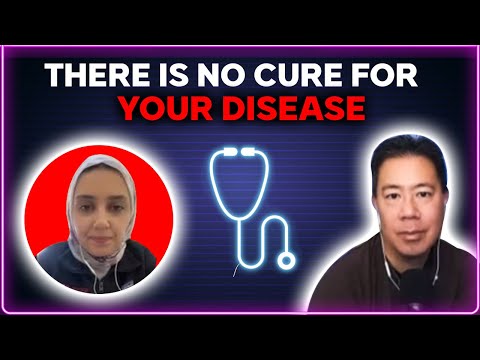
In this episode, we follow Houda Bouhmam, a radiology resident, as she struggles to deliver the devastating news to a patient that there is no cure for their disease. Despite the emotional toll it takes on her, Houda perseveres and shares the difficult news, shining a light on the strength and resilience of health care workers. Tune in to hear Houda’s powerful story.
Houda Bouhmam is a radiology resident.
She shares her story and discusses her KevinMD article, “There is no cure for your disease.”

The Podcast by KevinMD is brought to you by the Nuance Dragon Ambient eXperience.
With so many demands on their time, physicians today report record levels of burnout. Burnout is caused by many factors, one of which is clinical documentation. Studies indicate physicians spend two hours documenting care for every hour spent with patients.
At Nuance, we are committed to helping physicians do what you love – care for patients – and spend less time on clinical documentation. The Nuance Dragon Ambient eXperience, or DAX for short, is an AI-powered, ambient clinical intelligence solution that automatically captures patient encounters securely and accurately at the point of care. Physicians who use DAX have reported a 50 percent decrease in documentation time and a 70 percent reduction in feelings of burnout, and 83 percent of patients say their physician is more personable and conversational.
Rediscover the joy of medicine with clinical documentation that writes itself, all within the EHR.
VISIT SPONSOR → https://nuance.com/daxinaction
SUBSCRIBE TO THE PODCAST → https://kevinmd.com/podcast
RATE AND REVIEW → https://kevinmd.com/rate
FOLLOW ON INSTAGRAM → https://www.instagram.com/kevinphomd

ADVERTISEMENT
FOLLOW ON TIKTOK → https://www.tiktok.com/@kevinphomd
GET CME FOR THIS EPISODE → https://earnc.me/QETbSI
Powered by CMEfy.
Transcript
Kevin Pho: Hi, and welcome to the show. Rate and review at KevinMD.com/rate. Subscribe at KevinMD.com/podcast. Today on the show, we have Houda Bouhmam. She’s a radiology resident. Her KevinMD article is titled “There is no cure for your disease.” Houda, welcome to the show.
Houda Bouhmam: Hey, Kevin. Thank you so much for having me.
Kevin Pho: We’ll get into the article in a little bit. First off, briefly share your story and journey to where you are today.
Houda Bouhmam: Yeah, sure. My name is Houda. I was born and raised in Morocco. I then moved to the U.S. in 2010 for my higher education. I did my medical training in Hershey, Pennsylvania, at Penn State University. Then I joined the Philly and New Jersey area. I did my transitional year in Philadelphia, and then I moved to New Jersey for my diagnostic radiology training. Right now I am a third-year radiology resident in New Jersey.
Kevin Pho: What are some of the reasons why you chose radiology?
Houda Bouhmam: Radiology has a lot of starting from scratch and building up; it’s pure problem solving. We don’t see the patient, and we don’t get the clinical picture per se. We get a little bit of it to work with, but then again, we start looking at the images and walk our way to the diagnostic aspects of the story. That’s what I like about it.
Kevin Pho: What are some of the challenges and rewards of radiology today?
Houda Bouhmam: You’re trying to hunt for the diagnosis without enough information. That’s definitely one big challenge.
Kevin Pho: What would be an example of that? I hear this all the time. Let’s say you get a radiology result; it could be any X-ray or scan. Tell me about what kind of context you typically would get with that.
Houda Bouhmam: For example, before reading the X-ray or the CT, if you want to talk about cross-sectional images, that’s what we get more of, especially at night or during emergencies, and you get abdominal pain. I have to know which quadrant I have to look at and what the clinical picture is. Sometimes the clinicians don’t take the time to put in enough relevant information for us to help them find the reason for the clinical picture. That’s one thing that poses that challenge.
Kevin Pho: I’m a primary care physician. I order a lot of scans and X-rays. Tell us, from your perspective as a radiologist, what is the most important piece of clinical information that you guys need to know?
Houda Bouhmam: Absolutely. It’s the main reason the patient is getting that scan. We don’t have to know everything about the patient, but we have to know what you, as a clinician, think is relevant to the cause of the pain, or why the patient is having that kind of complaint to begin with. Also, if there is any personal history or family history, that would help us find it, because I call myself a hunter as a radiologist. Why is this patient having this? Why is this count in the blood analysis high? There has got to be a radiographic reason for me. I look inside the body to find an explanation for something you, as a clinician, told me. If you don’t mention it, and I don’t see the patient, I probably will not give you the answer you’re looking for.
Kevin Pho: OK. Before we get into your KevinMD article, I have to ask: What is one misperception of radiology that you would like to clear up?
Houda Bouhmam: I know there are a lot of misconceptions about radiologists. We are pretty busy. As a field of medicine, we are very, very busy, especially working at night or after hours. We work a lot with the ED, hand in hand, and the ED or the clinicians sometimes don’t get to the diagnosis; they need our help. So that’s one thing: Radiologists are important. There are some findings that are pretty obvious, and any clinician can pick them up, for sure, but there are others that need a more specialized eye, and that’s why we get trained. We do an intern year, then we do four years, and then we do some extra years of fellowship if you want to subspecialize in radiology. So that’s one thing.
The other thing is that we actually do like to talk to people. We do like to talk to clinicians, and we do love to be helpful. We only get to do that aspect of our work if we have a fruitful conversation with the clinician to get the relevant information, again, that we need to be as helpful as we want.
Kevin Pho: All right. Your KevinMD article is titled “There is no cure for your disease.” Tell me, how did this story come about?
Houda Bouhmam: I wrote this back when I was a medical student. As a third-year medical student at Penn State, I led a refugee initiative. It was around the time when we received a pretty big wave of Syrian refugees. At the time, I believe it was 2017 or 2018, something like that. I led a refugee initiative, and I was the only Arabic-speaking member, so that made me the leader of everything, and everything went through me before getting to my team members or the refugees themselves. We served 11 families. They were all from Syria, and they all only spoke Arabic, so I was the in-between person for every single transition, if you want, that happened in that project.
We did a lot to help the families with settlement: find jobs, get their driver’s licenses, and get around. They settled in Harrisburg, the capital of PA, so that’s where they settled. We used to help the kids get enrolled in school and help them with their homework. Again, they came in with zero English, which I thought was amazing: to come to a country without even knowing the language spoken there and try to establish a new life. That’s what we helped them with.
One family had a daughter who had a chronic disease, a genetic disorder, and she needed immediate attention. I had to find her a primary care doctor, and I was there translating. I remember my very first encounter. The daughter and the father were there, and I was there, and I had to translate because at the time they didn’t have any source of translation. I was the person who brought them to that primary care doctor, who nicely accepted to take them without them even having insurance, just considering the emergency of the matter.
Kevin Pho: What was the reason that she needed such urgent attention?
Houda Bouhmam: One of the biggest reasons that she was successfully transitioned to the U.S. is that she had a genetic disorder. Her sister died from the disorder in Jordan due to lack of care. So when she got here, she came with the idea that the U.S. has the cure for the disease. She was very passionate and very excited to get here and just get rid of the disease. It was a collagen disorder, and the only thing that you could see was her skin, which was breaking up. Basically, she was at a very high risk of infections, and she was not in an environment that would help her. The apartment was not clean, and there were many conditions that were not met. That’s why we needed immediate attention for that specific family, basically to save the daughter.
So yeah, I found her a primary care doctor, and I found myself translating. I really didn’t want to do that. I wasn’t a trained and certified medical interpreter at the time, but I had to do that for the refugees, to be able to join them and be with them in their medical encounters.
Kevin Pho: What happened next after you connected this patient to the primary care doctor?
Houda Bouhmam: She was amazing, and she got a whole group. Like I said, the condition affected all of her body, so she needed nutritionists, she needed, what else, dermatologists, a GI doctor, and all of that. The doctor at the time was talking, and she never mentioned the cure, but she was saying, “We’re going to mobilize all this team for you because you need to be able to eat well.” The condition was affecting her esophagus and her eating, and she wasn’t eating well. She needed many things like that, because my understanding was that the sister actually died from poor nutrition; that was the main reason. So the doctor was talking about all that, but the kid was really looking for, “I am here in the U.S., so why do I have to do all this? I was told that I would be cured of this disease.” I witnessed all that in the first encounter, and that’s what made me write about it.
Kevin Pho: Was there a cure for the disease?
Houda Bouhmam: No, unfortunately. The doctor was talking to her about optimizing her to be a candidate for a clinical trial, but there was no cure promised. Like I said, this disorder was in her genes. I didn’t have enough information when I first met them, but when I went with them to the encounter, I understood that they didn’t even know the disease, or they didn’t know if it was genetic. They kept saying, “It’s in our families,” but they didn’t understand. So I came to understand with them the nature of the disease, and I understood very well that there is no cure. It was just really hard for me to convey that information to them, with them coming in with that mentality that it’s all going to be gone here.
Kevin Pho: Take us to that moment. That moment must have been so tragic for that girl and her family. When you were translating and you were telling her that bad news, take us into that moment. What happened?
Houda Bouhmam: Initially, at the beginning of the encounter, I remember vividly, I was very excited, just like they were. I was translating sentence by sentence. Another challenge that I had working with the Syrian refugees is that they would ask for my medical opinion all the time in front of the clinician, and I would have to pause and explain, “I’m translating, and I’m trained to translate every word. We can talk about this when we are together, and I can give my opinion to the best of my knowledge, but we can’t go back and forth in an encounter like that.” There were many challenges; this was one of the biggest ones. I felt like they trusted me the most in every encounter just because I speak their language and I look like them to an extent. That was a big challenge that I had at the time.
The other challenge was translating the bad news. Part of me being a radiologist is avoiding that part of medicine. I would rather talk to clinicians and say, “This patient has cancer,” than communicate it myself to the patient.
Kevin Pho: Why did this story stick with you?
Houda Bouhmam: I remember the shock that the little kid had. She was 13 years old. We kept talking about optimizing care and not getting to where she wanted, to the cure. She kept repeating, “Well, what about the cure? OK, I understand all this. Can we move on? When is this all going to end?” I felt it was very harsh, and it was really hard for me. I kept pausing and avoiding looking at her, and her father, of course, and just saying things the way they are. It was very heavy and very challenging to do.
Kevin Pho: Do you know what happened to this girl?
Houda Bouhmam: Yes. Sadly, I moved from the area to continue with my training, but I’m still in contact with the mother. Unfortunately, they lived through the horrors of sparing her from COVID, so they isolated themselves so that she doesn’t get the infection. She was in and out of the hospital, but she’s still doing OK on all of the optimization of care. The providers at Hershey did an amazing job. The team she has is great, and the dermatologist who was taking care of her provided her with a lot of things and is keeping an eye on her. As far as I know, she’s not ready for the clinical trial, but they are trying to spare her any serious infection that would put her life in danger.
Kevin Pho: How did this whole story affect you as a physician?
Houda Bouhmam: Stories with my patients: Although I am a radiologist and I don’t have as much contact as the other clinicians do, the impact is there, and I always remind myself that those are humans before they are patients. They may come with stories; they come with scars. We as physicians have to do our best to give them comfort, and one of the basic things of that comfort is having them understand everything we say. Part of why I went through the training to be a certified medical interpreter while I was a medical student is that I wanted to do it the proper way. I wanted to give them that comfort. I knew they were coming with so many scars and so much fear to begin with. To be in front of a physician in a different country during your first days of settlement is not easy.
So it stuck in my mind, and it reminds me each time, because I do have encounters with patients until now. I do LPs, I do IR procedures, and I go talk to patients, sometimes when I scan their kids at night. I always keep in mind that those are humans to begin with. They have stories. Sometimes it’s a big accident and they lost family members, so I have to always be aware of that and translate even if we’re speaking in English: Go in layman’s terms, go at their level, make sure the understanding is there, and make sure they have the comfort they want. Anything I as a physician can provide, I try to do, and my stories with the refugees taught me a lot in that regard.
Kevin Pho: My final question: What are some of your take-home messages that you want to leave with the KevinMD audience?
Houda Bouhmam: My final message is, first of all, to every clinician, whether you are a medical student, a resident, or an attending: Deal with your patients like your family members. I think that helps best. Provide them with the best care, not only the actual medical care, but have in mind that there’s no reason for them not to have a good experience, a good encounter experience. If they don’t speak English, make that effort to find an iPad or to find a certified, trained interpreter to make sure they understand everything you say. Make sure you comfort them, because we get busy. We are busy people, so sometimes we forget that this patient needs to understand the treatment 100 percent. There’s no reason for them not to. So my message, again, is to take the time and take the effort to give that extra bonus of experience to every patient, because I believe that everyone deserves that.
Kevin Pho: Well, thank you so much for sharing your story, time, and insight, and thanks again for being on the show.
Houda Bouhmam: Of course. Thank you very much for having me. It was a pleasure.