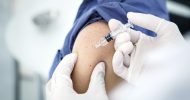
My position on the H1N1 flu vaccine is clear: everyone should get it.
But not every physician shares that sentiment. The Washington Post reports that there are a minority who are unconvinced of the vaccine’s safety and believe the H1N1 pandemic is over-hyped.
Worse, they aren’t vaccinating their patients. And when you’re talking about pediatricians, that can mean trouble for their patients; children who are most susceptible to the damage caused by H1N1.
According to the CDC, “this is the same manufacturing process, the same manufacturers, the same factories, the same safeguards as the seasonal flu vaccine that has been used for more than 100 million doses each year for many years and which has an excellent safety record.” So let’s get that out of the way first.
Like those who oppose vaccines against polio, mumps, measles and rubella, it is this vocal minority who have a disproportional influence as they express their views to the media. It does no good for these skeptical doctors to further confuse patients with conflicting information, and fail to vaccinate those at high-risk from H1N1’s effects.
What if they’re wrong?

Related posts:
- How will the H1N1 vaccine be distributed to patients?
- What the H1N1 vaccine recall means for kids
- Does the seasonal flu vaccine offer protection against H1N1 influenza?
- Don’t wait for the H1N1 vaccine before you get your flu shot
- "We cannot pay for the vaccination of the American public any longer"
- Rich countries are selfish when it comes to vaccine safety
- Vaccines: Rising costs are putting children at risk


{ 8 comments }
I agree, but I don’t think the vaccine should be mandated, unless it is for public health reasons. There are always folks who eschew established medical care for a variety of reasons. There is a vocal anti-vaccine group, for example, who are convinced that certain vaccines have caused autism, despite the absence of convincing scientific evidence that this is the case. I rec’d the H1N1 vaccine, more to protect my patients than myself.
Did you read the CBS news information regarding how many cases of swine flu were actually detected before they stopped actually testing for it?
The investigative journalist Sharyl Attkisson (a CBS News correspondent and investigative reporter. She was also part of the CBS news team that received the Edward Murrow Award in 2005 for overall excellence. Additionally, she received an Outstanding Investigative Journalism Emmy in 2002 for a series on the Red Cross.)
Her investigation found:
“The CDC explained that one of the reasons they quit counting was because of all the flu that’s out there, most are swine flu. Well, that’s true. Most of the flu that was out there was indeed swine flu, but they failed to say that most of the suspected flu was nothing at all. And I think that’s the caveat the public just didn’t know,” Attkisson explains.
She gives even more striking examples of the numbers the investigative report revealed. For instance:
In Florida, 83 percent of specimens that were presumed to be swine flu were negative for all flu when tested!
In California, 86 percent of suspected H1N1 specimens were not swine flu or any flu; only 2 percent were confirmed swine flu.
In Alaska, 93 percent of suspected swine flu specimens were negative for all flu types; only 1 percent was H1N1 flu.
Hey Kevin
Great website, very informative. Where I live, the H1N1 vaccine is a big hit…or bust.
Just started my own site, more of a human nature viewed through medicine perspective, but enjoyed yours while I’m checking out med blogs.
Thanks again. Will follow.
I have to say I’m among the doctors who are against the H1N1 vaccinations. Because of the expedited production of the vaccine in order to get it to market, mercury is being used in the vaccine. This simply is not good.
Also, over the past few weeks, the H1N1 is on the decrease even though the vaccine is still mostly not available to the masses. I think “good hygiene” can explain why we are seeing a decrease in infections at this time. Medicine offers that very well.
The media hype over the H1N1 is way over emphasized. It’s marketing at its best and who makes the profits? The pharmaceutical companies. They’re making millions off the H1N1.
I don’t think vaccinating in any fashion should be taken so lightly. You’re injecting chemicals into the blood and the body will respond somehow. There are side effects.
My blog focuses on asking the hard questions and demanding real answers.
Keep up the great work Dr. Kevin. Love reading your blog
“According to the CDC, “this is the same manufacturing process, the same manufacturers, the same factories, the same safeguards as the seasonal flu vaccine that has been used for more than 100 million doses each year for many years and which has an excellent safety record.” ”
Not that I disagree with the overall sentiment of the post, but wasn’t there a British vaccine producer who was cited for ridiculously unsanitary conditions leading to problems with the vaccine just a couple years ago?
Everything that I have read is that the 2009 nodel H1N1 influenza vaccine has or does not have thimerosal (the mercury containing preservative) the same way that the regular influenza vaccine has or does not have. I.e. if you are concerned about the thimerosal, the nasal spray vaccines and the single dose prefilled needles from two of the three manufacturers are thimerosal-free (and the single dose prefilled needles from the third manufacturer contain only trace amounts of thimerosal). The multidose bottles of injected vaccine are the ones containing thimerosal.
I am extremely curious. I have not seen any numerical data accruing to the *individual* yet, as to benefits, modified by expected population immunization rates and baseline immunity. In terms of risks, we have reasonably good data in terms of % anaphylaxis.
I am friends with a mother. Her daughter, Kim, and Kim’s best girlfriend gave birth around the same time. Kim was against vaccinations after reading up and studying both sides…..while Kim’s bestfriend did not investigate.
While passing by the local Health clinic after the babies were about 10 months old….Kim’s bestfriend said “Let’s get the kids vaccinated today”….Kim decided against the idea but her bestfriend went ahead and had her child vaccinated.
Later that day when Kim reconnected with her friend she noticed that her friend’s child was looking different….with a glazed look in her eyes. Well, her friend said that it was just the sleepiness from the vaccine. However, from that day forward, that glazed look became autism…and her child has never recovered from her autistism.
There are many stories like this when one searches.
In my view vaccinations are too risky ….better to simply stay healthy
Comments on this entry are closed.